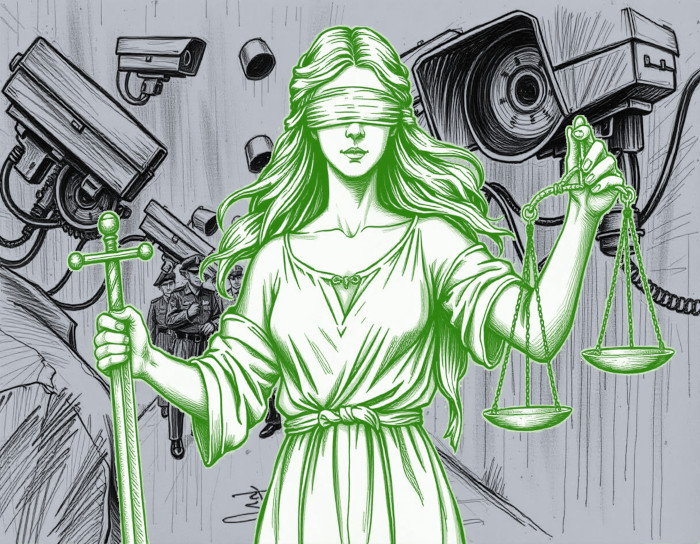
Natural Law vs. Man-Made Laws
What distinguishes Natural Law from human-made legislation? A comparison of the two systems — their origins, their legitimacy, and their effects on human freedom.
In our first article, What Is Natural Law? we developed a basic understanding of natural law. Now, we wish to build on this knowledge by comparing natural law with the man-made laws of our time. By doing so, we can gain insight into the current state of humanity.
We live in a society in which almost every aspect of life is governed by laws. From the moment we are born, we receive our first legally regulated documents: our birth certificate and tax identification number. These laws and regulations officially exist to ensure order, justice, and security in our society.
But are these natural orders or true justice? Is this security granted to everyone, or is it a means of safeguarding power structures for those in positions of power?
Human Morality
The fundamental difference between natural law and man-made law is the definition of human morality. Natural law is based on universal, immutable, and objective morality. This means that this morality applies equally to everyone and can be clearly defined anywhere in the world at any time. Moral behavior does not intentionally cause harm to another sentient being. In essence, this means that one’s behavior does not constitute theft. Theft may concern another person’s life, property, physical integrity, or freedom of choice. Understanding the objective distinction between right and wrong behavior is key to guiding human behavior. According to natural law, this mechanism is embedded in our world. Based on the principle of cause and effect, it determines the collective coexistence of a society.
Unlike natural law, man-made laws are based on moral relativism. Moral relativists believe that morality is relative or subjective. What constitutes right or wrong behavior can vary depending on the time and place. Moral relativism is the belief that people can decide what is right or wrong arbitrarily, acting as arbiters of moral and immoral behavior based on their personal preferences at a given time or in a given place. Examples of moral relativism include killing by the military, deprivation of property or physical integrity by the executive branch of the state, and deprivation of personal decision-making power by the government based on applicable laws and regulations.
Human laws that are consistent with natural law and objective morality are superfluous. If a human law is contrary to natural law, then it is wrong and immoral and can never be legally or morally binding. Whether something is legal or illegal does not make it moral or immoral.
Equality Before the Law
According to natural law, human rights are inalienable and universal birthrights that cannot be granted or revoked by human processes or actions. These rights derive from nature. This means they existed before human existence and are inherent in creation itself. According to natural law, every human being has the same rights everywhere and at all times.
However, in today’s society, human rights can be arbitrarily granted or withdrawn by an artificially created higher state authority. Under this system, not everyone is held equally accountable for their moral or immoral behavior, and people have different rights depending on their position of power. Examples of this can be found in politics, the judiciary, the military, the police, and other state institutions. When a person is born into this society, they have no rights unless the state grants them permission. This applies to travel, work, housing, medical care, freedom of expression, and almost every other human activity.
Understanding vs. Authority
An understanding of natural law is based on the objective distinction between right and wrong behavior, as well as the inherent mechanisms of cause and effect. The more aware a person or society is of these mechanisms, the more harmoniously they live in accordance with natural law. This applies invariably, always, and everywhere. A person’s behavior conforms to natural law through their capacity for reason and reflection on the natural world and human nature.
Man-made laws are created and enforced by human authorities. This authority is an illegitimate, artificial construct that does not exist in nature. Man-made laws are morally illegitimate and, therefore, not morally binding when they conflict with natural law. Moral actions are always based on voluntary choice. This means there is mutual consent among all those involved. State laws, including those that mandate behavior and dictate rules such as prohibitions, taxes, and licenses, are not voluntary. They are commands to conform that are enforced through the threat or use of force. Man-made laws are the arbitrary decrees of a ruling class seeking to dictate the lives of others unlawfully.
These laws vary by country and the whims of their respective legislators. People do not obey these laws because it is in their nature to do so but rather out of fear of being punished for not complying. This is why people pay taxes, obtain driver’s licenses, passports, planning permission, work permits, etc. Man-made laws are enforced by the authority of the state and are based on violence and coercion.
Conclusion
The laws of our society are at odds with natural law and ignore fundamental truths. Humanity pays the price for this ignorance with a seemingly endless cycle of war, chaos, violence, suffering and lies.
| Natural Law | Man-Made Laws |
|---|---|
| Based on truth and principles (inherent in creation) | Based on dogmatic belief (a construct of the mind) |
| Implemented through knowledge and understanding | Implemented through fear of punishment |
| Universal, exists everywhere | Varies from place to place according to the whims of lawmakers (Moral relativism) |
| Eternal & unchanging | Changes from time to time according to the whims of legislators (Moral relativism) |
If we are to bring about peace and meaning in this world, we must reflect on our inherent nature. Natural law embodies our inalienable and universal birthrights. These are the only true human rights, and they cannot be granted or taken away through artificial processes or actions.
The societal belief that some people have more legitimate authority over others or that some people have more or fewer innate rights than others is one of the most fundamental causes of unparalleled suffering and chaos in our world. Such authority is a false, deceptive, and immoral claim that is unfortunately accepted and believed by most people with religious zeal. The so-called delegation of authority to politicians, police officers, and the military is fundamentally illegitimate and cannot exist in nature. One cannot bestow or delegate what one has never possessed.
Human morality is objective and does not change arbitrarily. There is an objective distinction between moral and immoral behavior. For this reason, any form of imposed authority—be it by a king, government, or any other entity—is morally illegitimate. The concept of rulers and the ruled is not based on the free will of those involved. It is enforced through violence and coercion, making it immoral. The color of the ruling government makes no difference.
Series of articles: Natural Law
-
What is natural law?
-
Natural law versus man-made laws
Series: Natural Law
- 1What is Natural Law?
- 2Natural Law vs. Man-Made Laws
- 3The Dynamics of Natural Law
You might also like


New articles directly on Telegram
Follow @agorahoch3 and never miss a new post.