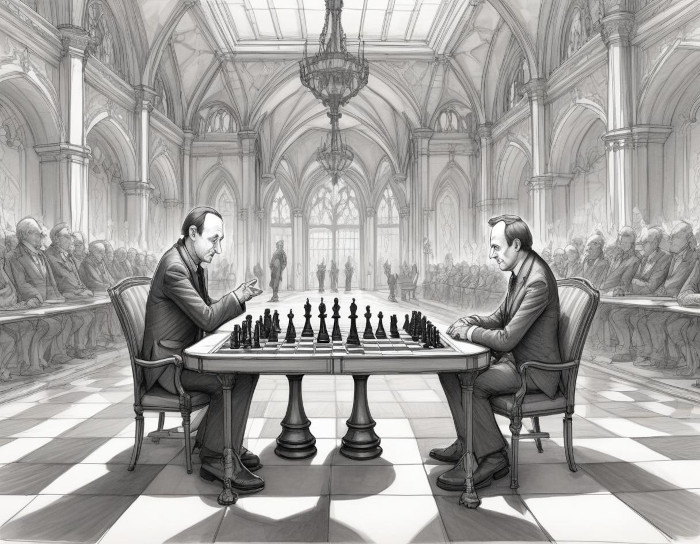
Divide and Conquer
Divide and conquer is one of the oldest strategies of power. This article analyzes how it works today — and what we can do to resist it.
The political strategy of "divide and conquer" — or better known historically under the Latin expression "divide et impera" — is probably as old as the organized will of various individuals to rule over the rest of humanity. The underlying idea essentially describes the application of various tactics to split a people or group of people into smaller factions that fight each other in order to be able to control them more easily.
Thus, the Roman historian Tacitus already described this common practice around 100 AD in his work 'Agricola'. The Roman Empire played local tribes or ethnic groups against each other so that they could not jointly rebel against Rome. The Italian writer and philosopher Machiavelli also described this tactic in his book 'Il Principe' ("The Prince") around 1532 in his significant work on power, politics, and rule:
"A clever prince must find methods to sow discord so that his subjects need him." [Machiavelli in "Il Principe," 1532]
And even though the Roman Empire only exists in the history books, this extremely successful tactic of rulers has only evolved and has been adapted and refined to the respective times and epochs. Let us look at today's political stage and the division of peoples into left and right camps.
It should be noted that the tactic of divide and conquer is by no means limited to political camps. It finds its application between the sexes, cultures, skin colors, generations, or social classes.
The terms "left" and "right" originally come from the French Revolution (1789). At that time, in the French National Assembly, the revolutionaries and reformers sat to the left of the parliamentary president, the conservative supporters of the king to the right. This seating arrangement established itself as a political metaphor and was later adopted worldwide. The political term "left" originally stood for liberal ideas such as the free market or human rights and was only increasingly associated with socialist and communist movements in the course of the 19th and 20th centuries. The political right historically stood for conservative forces that wanted to protect the monarchy, church, and existing elites.
Interestingly, these terms have changed significantly in today's political parlance. In recent years, for example, people who took to the streets against existing power relations, lockdowns, or other government regulations have been placed in the right-wing political corner. The political left today tends more toward a strong state and the restriction of the free market. In fact, in recent years many left-wing forces have even taken to the streets in support of the government.
Contemporary Application
If we now look at today's political climate in society, we find across all social classes and in both political camps above all a great deal of hatred and resentment between the parties. One might almost think that the division of the people into left and right and the sowing of discord through politics could hardly have been more successfully achieved.
But how did this come about, and do I really have to hate my neighbor just because they hold a different opinion? To answer this question, let us first look a little more closely at the basic attitudes of most "liberal" and "conservative" citizens, removed from the political stage of left and right.
People from the liberal spectrum see themselves as socially minded and cosmopolitan. They want the poor to be helped and for there to be basic social justice in society. They want to live their love freely and care about the environment.
People from the conservative spectrum want to preserve the values of the traditional family and represent Christian values such as honesty, diligence, and a sense of responsibility. They want people who work hard in our society and create real added value to be rewarded for it and to be able to keep the fruits of their labor. They are proud of their culture and want to be protected from criminal intruders.
When you look at both arguments, there is actually no reason for conflict. If you read both "wish lists" to an average person, they will probably agree with everything. Each individual point has an individual weight for each person, but hardly anyone will strictly reject the basic values of the other side.
Some would say they want to live with friends in a commune, give something to the poor and needy, and occasionally organize a rave. Their neighbors might say they want to get married and start a family, start their own craft business, and live in a large house. Even if they see some things differently and can't relate much to the other's lifestyle, neither side will feel morally justified in imposing their worldview on the other. So far, so good.
All this changes with a single magical ingredient: an external authority. Suddenly it is morally legitimate to impose one's own worldview on one's neighbor, as long as these measures are carried out by the authority — in the current case, the government.
And suddenly the liberal says: "I will prohibit you from driving a car with an internal combustion engine and eating meat every day. I will force you to hire the people I think should work for you, and I will force you to pay them what I consider fair. I will force you to give something to the poor."
And the conservative says: "I will force you to pay for the military. I will make it as difficult as possible for your foreign friends to come to Germany."
Where has mutual tolerance gone? The monster called "authority" has devoured it.
The left party front whispers softly into the liberals' ears: "Imagine we could force property developers to rent their apartments cheaply. Imagine we could force every citizen to finance our climate agenda. Imagine we could force companies to pay their employees higher wages."
At the same time, the right party front whispers to the conservatives: "Imagine we could make the military so large that no one would dare attack us anymore. Imagine we could subsidize the companies that deserve it. Imagine we could close the borders and let no more illegal immigrants into our country."
And together both political camps chorus: "All this can come true, if you only give us the power to simply implement it!"
It is that simple to turn peaceful neighbors into bitter enemies. Normally, the average citizen does not feel morally justified in using violence against their neighbor. The individual citizen actually feels morally justified in using violence only to defend themselves or others against direct violent attacks. Violence exercised by "authority," however, is justified and legitimate for most people.
Of course, for the basic mechanisms of politics it is completely irrelevant whether a more left-wing or right-wing party governs. State debt continues to grow, wars and arms exports continue to be financed, and the ruling political class enriches itself through its position of power. A good example of this is the change of government in Germany in February 2025. From a more left-liberal government with Red-Green to a more right-conservative government with the CDU. If one couldn't recognize it by the different colors of the parties, one would hardly notice the change of government: the war course, the climate agenda, rising state debt, and the expansion of the technocratic state continue without pause.
And yet these elections between the established major parties and the political theater between left and right are of crucial importance for the game of divide and conquer. For now all cards can be played.
Through the recurring change of power, left and right parties can publicly pass the buck to each other as soon as it comes to tax increases, restrictions on individual freedoms, or other negative consequences of politics. And as if that weren't crazy enough, citizens direct their displeasure about such measures not against the politicians who implement them, but against their own neighbor who voted wrong with their wrong opinion. Game, set, and match for politics and big capital.
Those who want to better understand these mechanisms and the structure of politics are recommended the books by Larken Rose: "The Most Dangerous Superstition" and "The Iron Web."
You might also like


New articles directly on Telegram
Follow @agorahoch3 and never miss a new post.