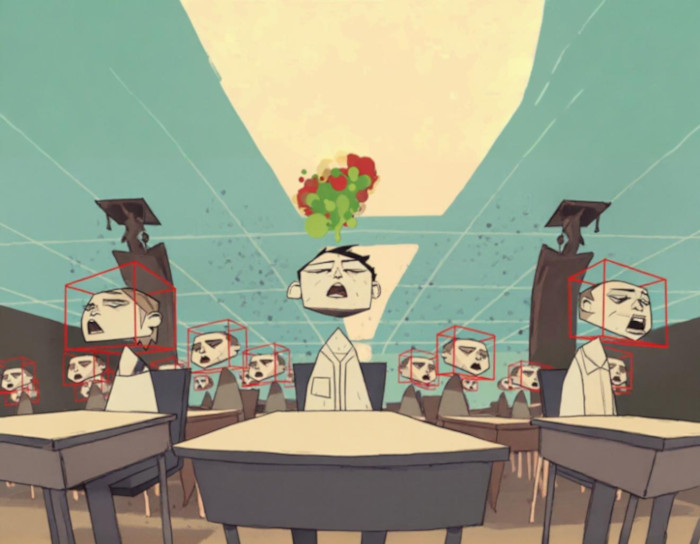
Overcoming Compulsory Schooling
Compulsory schooling was not designed to serve children — it was designed to produce compliant workers and citizens. This article explores the history of school compulsion and the alternatives available today.
For many, the public school system is an unshakeable concept of our society. It is seen as the central place of socialization, knowledge acquisition, and the promotion of equal opportunities. Our agoristic analysis argues, however, that state-controlled schooling primarily serves as an instrument for ideological conditioning and does not offer genuine education. This article examines the possibilities and options for parents and children to free themselves from this system. The focus is on understanding its mechanisms and accepting alternative educational paths. This article summarizes the results of our in-depth analysis and concentrates on finding solutions. Those who are more interested in this topic area and are looking for source references will find them in our research section.
The Structure of State Schooling
Looking at the history of humanity, centralized, coercion-based education by the state aims at forming loyal and conformist citizens. During the Reformation, control over education was merely transferred from the church to the state, but continued to serve the imparting of political and social values — and does so to this day. Examples such as the Third Reich and the GDR show how the Prussian school system can be used to enforce harmful ideologies through conformity and propaganda, suppress critical thinking, and promote obedience.
As with so many sociopolitical topics, the core problem lies in the centrally planned and forcibly enforced obligation. Governments and educational organizations use compulsory schooling to influence and manipulate the thoughts of young people on the basis of their own worldview, thus forming loyal and conformist citizens. While social justice, integration, and economic stability are officially promoted, the system often places value on shaping individuals to conform to the status quo.
From a philosophical perspective, the educational approach in state schools largely corresponds to the sophistic method of knowledge transmission. Here the teacher acts as an expert and imparts knowledge directly, which pupils are to passively absorb, retain, and apply. This stands in strong contrast to the Socratic method: the teacher here acts as questioner and guide and encourages pupils to actively explore and discover truth for themselves through inner understanding. We have examined this background in more detail in our analysis.
The Strict Reality in Germany
In Germany, compulsory schooling, with the generally applicable requirement to be physically present in the school building, is particularly strict. Unlike countries such as the USA, Canada, or Great Britain, homeschooling is fundamentally prohibited here. Even private and alternative schools such as Montessori or Waldorf schools are subject to state supervision and must implement prescribed curricula. Article 7 of the German Basic Law states: "The entire school system is under the supervision of the state." This means that all children are expected to receive a standardized, state-prescribed education in a controlled environment. This requirement can be enforced with fines and even the withdrawal of parental custody.
Contemporary Control Mechanisms in the 21st Century
Even today, the patterns of ideological conditioning and control continue in the state education system. To name three examples here:
Militarization:
In recent decades, we have seen increasing cooperation between state schools and the Bundeswehr, with the goal of enthusing young people for war and service in arms. In March 2024, for example, the then-Minister of Education Stark-Watzinger spoke out in favor of a more relaxed relationship between schools and the Bundeswehr. Schools are to prepare children for the event of war, for which youth officers are to advertise for the Bundeswehr's work at schools. According to an official statement by the then-Red-Green federal government from April 2024, cooperation agreements exist between state ministries of education and the respective regional commands of the Bundeswehr in 9 federal states.
Alignment:
With their own guidelines for teachers and expert groups, the EU Parliament and the German federal government are pushing from the top down into European classrooms, in order to erect a firewall in the child's brain with prebunking and inoculation techniques. Under the guise of combating disinformation and promoting digital competencies, young people are ultimately to learn to personify societal currents and to suspect a conspiracy of "malicious actors" behind opinions that displease the ruling institutions. The pupils are meant to become more resistant to system-critical arguments through psychological manipulation.
Digitalization:
The increasing digitalization of schools is accompanied for the youngest generation by concentration disorders, media dependency, social isolation, and further health damage. Organizations such as the Conference of Ministers of Education and Cultural Affairs (KMK) and the Federal Ministry of Education and Research (BMBF) are driving this transformation — officially sold as progress — with billions of taxpayers' money, often in close cooperation with Big Tech companies and influential foundations such as the Bertelsmann Foundation. The goal of this transformation is to convert schools into data-producing organizations with the help of learning platforms, databases, and surveillance instruments, and to establish a technocratic steering and management logic in the field of education.
Paths to Freedom: Options for Parents and Children
First and foremost, it is of crucial importance to recognize the patterns and inherent mechanisms of centrally controlled and coercion-based school systems.
Even though it is often incorrectly portrayed as such: the state school system does not serve individual education or the promotion of critical thinking. Rather, it is a central instrument for ideological control and for securing the status quo. Once we understand this, we can empower ourselves and our children to free themselves from the centralized, state-regulated educational model.
In a second step, we should inform ourselves about the existing alternative possibilities and philosophies, so that we can make a better, self-determined decision in the interest of our children.
Here are the most important options and approaches:
1. Making use of legal frameworks:
While strict compulsory schooling applies in Germany, in countries such as Austria and in some regions of Switzerland there is only an educational obligation. This means that parents must ensure that their child receives a general education. However, this need not necessarily take place in a traditional school. It is possible there to educate children at home.
2. Exploring alternative school models:
In Germany, in addition to state schools, there are also free, alternative schools such as Montessori, Waldorf, or Sudbury schools. These schools offer different pedagogical concepts and teaching methods. Parents should be aware, however, that even these schools must comply with state regulations and may be compelled to join the state's digitalization and conformity efforts. Thorough prior research is therefore indispensable.
3. Studying alternative learning methods and educational philosophies:
In the German-speaking world, there is now a growing number of people who recognize the destructive mechanisms of state-controlled education. The Austrian memory trainer and educational activist Ricardo Leppe offers with his platform "Wissen schafft Freiheit (WSF)" [Knowledge Creates Freedom] a suitable point of contact for all interested pupils and parents. There one can find free courses on alternative learning methods as well as networks for schools, initiatives, and teachers who wish to spread alternative educational models. Leppe advocates for a decentralized, child-centered "school of the future." In the German-speaking world, Chris Fader also offers online courses and coaching for families who want to raise their children without school. He also offers a platform for this growing community of parents.
4. Making use of community and information:
In the German-speaking world, there is a large and growing community that is engaged with alternative educational systems and school-free concepts. Thanks to the internet, this knowledge is easily accessible and often "just a mouse-click away." With a little personal research and creative ideas such as postings, one will certainly also find like-minded people at one's own place of residence with whom one can exchange and mutually support one another. The number of parents interested in alternative educational systems is larger than it appears. Be courageous!
5. Parents' own initiative:
Ultimately, parents must recognize that young people are one of the most valuable resources on earth. They should not leave the education of their children entirely to a centrally controlled state system or a future AI. It is of crucial importance to communicate actively and consciously with children about these topics and to lead by example — particularly regarding reading and promoting the love of learning. The decline in reading motivation among the younger generation can be counteracted, for example, by giving priority to reading aloud at home.
Conclusion and Further Recommendations
The state-controlled school system does not always act in the best interest of children, but rather pursues certain ideological and sociopolitical goals. When parents understand these mechanisms, they can empower themselves and their children to choose educational paths that promote genuine learning, critical thinking, and individual self-determination.
Further sources on the topic of school:
- The work of Ricardo Leppe and his platform "Wissen schafft Freiheit" [Knowledge Creates Freedom].
- Our agoristic analysis of the state school system.
- The book "Deschooling Society" by Ivan Illich.
- The first chapter of the documentary series "The Pyramid of Power" by Derrick Broze.
You might also like


New articles directly on Telegram
Follow @agorahoch3 and never miss a new post.