The Shamanic Roots of Christmas (Part 1)
Christmas and shamanism: how the fly agaric mushroom, shamans and pagan rituals shaped our Christmas traditions — and what this reveals about consciousness.
Christmas is undoubtedly the most well-known festival in the world and full of strange customs. But who has ever wondered why we place fir trees in our homes every year at Christmas and lay colorfully painted, red-and-white gifts beneath their branches? And why does a bearded man dressed in red and white on a sleigh drawn by flying reindeer bring us gifts? As a sign of our love for one another?
Looking at the origins of these Christmas traditions, many can be traced back to shamanic rituals of our ancestors. In fact, this Christian festival with all its current customs and traditions conceals surprisingly many similarities with ancient shamanic customs. More precisely, we find this Christmas symbolism among our Northern European ancestors in the cold and snow-covered Siberia.
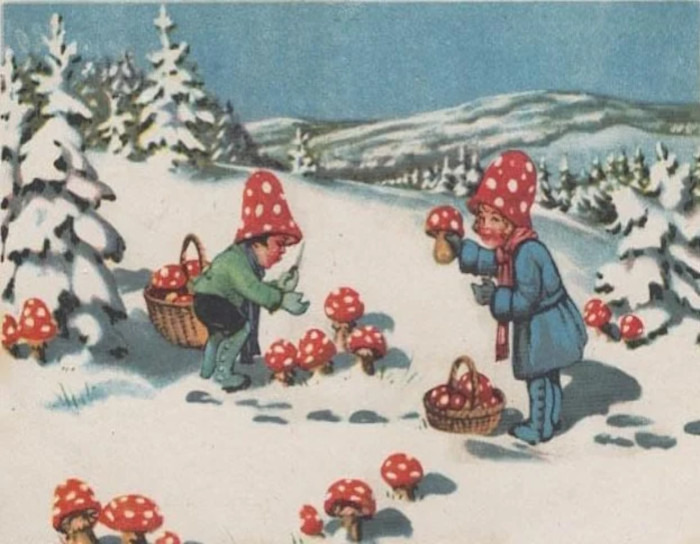
So let us forget for a moment the Father Christmas living at the North Pole with his helpful elves and instead imagine old shamans in red-and-white, fur-trimmed coats and long black boots, wandering through the snow-covered forests of Siberia around the winter solstice and collecting red-and-white fly agaric mushrooms under the fir trees. Does that sound familiar?
The Shaman as Ancestor of Father Christmas?
The large, red-and-white spotted fly agaric has been one of the most well-known mushrooms in the world long before Super Mario. And although it is regarded with suspicion and caution in our society today, it is colloquially considered a symbol of good luck. There is, for example, the well-known German expression: "You lucky mushroom!" (Du Glückspilz!)
In the shamanic traditions of the tribal peoples of pre-Christian Northern Europe, however, this mushroom was considered sacred and was prized for its strongly hallucinogenic properties. The fly agaric contains the psychoactive substance muscimol, which is often described as dream-like and occurs exclusively in species of the genus Amanita.
Traditionally, the ancient shamans collected these magical mushrooms every year at the winter solstice in the fir forests of Siberia. In doing so, they dressed like Father Christmas. To this day, Siberian shamans wear festive red-and-white fur coats when foraging for mushrooms. According to ancient tradition, the gatherers picked the mushrooms and laid them on nearby pine branches to dry, similar to the colorful ornaments on our Christmas trees. Thus the mushrooms partially dried for later consumption and made carrying easier. For afterward, the ancient shamans stored the collected mushrooms in their brown sacks and carried them to the village. Does this now slowly sound familiar?
But hold your breath, it gets even better! These peoples lived in dwellings made of birchwood and reindeer hides, the so-called yurts. When the entrance to the huts was covered meters deep in snow, one used the smoke hole open in the middle of the yurt. The shamans then went from house to house, climbed down through the smoke hole, and distributed the sacred gifts of nature. The grateful villagers hung the mushrooms around the fire or dried them in hung-up stockings. The important drying process reduced the toxins in the mushrooms and increased their psychedelic potency.
The flying reindeer that pull Father Christmas's sleigh could also be connected with these mushroom rituals. Reindeer also like to eat Amanita mushrooms, and according to old traditions, some people in Siberia even drank the urine of the reindeer after they had consumed the mushrooms. The reindeer filters out the harmful toxins and one receives only the hallucinogenic effect. Whether one then deliberately wanted to eat yellow snow or how one obtained the urine is unfortunately not known. The feeling of lightness and flying after consuming such a mushroom could, however, also have inspired the myth of Rudolph and his flying companions.
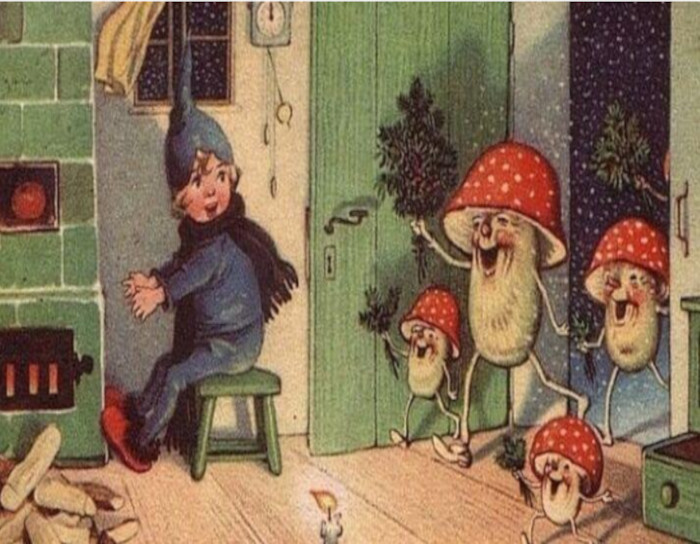
The spirits of the spiritual world that appear during such an Amanita muscaria ceremony could also be responsible for the idea of the helpful elves. The whole image of Father Christmas is in fact very similar to a mushroom.
Imagine, therefore, that Father Christmas may originally have been a mushroom gatherer or a shaman! Instead of distributing toys, however, he collected fly agaric mushrooms and distributed this sacred gift of nature with its psychoactive substance muscimol to the waiting villagers.
Winter Solstice: A Celebration of Rebirth
Another obvious connection between the traditions of tribal peoples in pre-Christian Northern Europe and the annual Christmas festival is the temporal sequence. While with the Christmas festival we celebrate the biblical birth of Jesus on December 25 in Bethlehem, our indigenous ancestors celebrated this time of year as the rebirth of light. The winter solstice takes place every year around December 21 and marks on the Northern Hemisphere the shortest day of the year. From this point on, the days become longer again and light triumphs over darkness. The sun reaches its lowest point in the sky on this day and remains there for approximately 2 to 3 days each year almost unchanged. The term "solstice" (solstitium) comes from Latin and means "standstill of the sun." Around December 24 or 25, the sun begins its course again and the light rises once more. The winter solstice and the Christmas festival are therefore closely connected.
Conclusion
There are surprisingly many similarities in the ancient customs and symbolism between our current Christmas tradition and the shamanic customs of our ancestors on the European Northern Hemisphere. The annual timing of the Christmas festival also fits very well into this pattern. The origin of our Christmas traditions could therefore be more complex than we imagine. Perhaps this festival is rather an invitation to explore our past and connect with nature and ourselves. Love and mutual universal connectedness of all people should be in the foreground.
So live the ancient traditions of our ancestors and forget our false materialistic and consumption-oriented Western dogmas when this sacred time of year arrives.
On this topic, also take a look at our video "The Indigenous Origins of Our Modern Christmas Traditions."
You might also like

New articles directly on Telegram
Follow @agorahoch3 and never miss a new post.