An Agorist Analysis of the German Media Landscape
Who controls the German media? This analysis examines the Bertelsmann empire, public broadcasting, and the power structures behind Germany's media landscape — with solutions.
Disclaimer: This work serves to educate and raise awareness, following the agorist principle of peaceful and holistic problem-solving. The research findings are intended to improve our shared social life as a human family and are made freely available to all interested parties at all times. The research was conducted without funding, support, or motivation from third parties and is based on freely accessible information. The work was created for purely informational and non-commercial purposes.
Abstract
Most people believe that when choosing their preferred print media and television programs, they can select from a wide variety of free and independent journalists and editorial teams, and that these media pursue the sole goal of informing consumers in a diverse and open manner. As we show in this work, this is far from the truth. The most important media in Germany are controlled by exactly three centralized institutions. Germany’s most influential media conglomerate has, since its founding, repeatedly sought proximity to the political elite without moral integrity, in order to maintain and expand its influence. Furthermore, there are striking historical examples of governments using their own media to control and distract their populations. We present solutions for how we can free ourselves from the media-sold, externally controlled, and pre-fabricated narratives and empower ourselves free from hostile programming.
Keywords: Agorism, Solutions, Bertelsmann, Media, State Television
Introduction
For the average citizen, the day begins by informing themselves about the most important events through their preferred news channels, newspapers, and social media. People from all political camps have a need to stay informed about the world around them and the topics of interest. The average citizen may believe that hundreds of television channels, millions of websites, and the endless feeds of social media represent an inexhaustible source of objective and reliable information. Yet, just as in the field of education, there are many concerns and conflicts of interest in the established media as well. Let us first take a look at the history of media ownership and the current power dynamics in Germany.
Already in the 19th century, before the founding of the German state, the first daily and weekly newspapers emerged with technological progress and the invention of the high-speed press. At that time, these media were still more clearly aligned with specific parties or political groups and were mostly referred to as the “partisan press.”
Already in 1835, the Gütersloh bookbinder and printer Carl Bertelsmann founded the Bertelsmann publishing house. The company started as a printing house and bookshop, publishing primarily religious literature and state school textbooks. [1]
From 1871, the formerly independent German states were united into the German Empire, and national media began to establish themselves. The first major publishing houses such as Ullstein Verlag, Scherl, and Mosse were founded. In 1917, the first German film company was created with the Universum Film AG (UFA). [2]
Already since the 19th century and through both World Wars and into the postwar period, the media in Germany were at regular intervals subject to political censorship and manipulation by the then-ruling political class. Since 1949, Germany has been formally divided, and in both German states — with public broadcasting in West Germany and the party press in the GDR — state-controlled and directed media houses emerged again.
In 1946, Axel Springer founded his own publishing house in Hamburg with an official license from the then-British occupying power. Axel Springer drew on the private assets of his father Hinrich Springer, who was owner of the publishing house Hammerich & Lesser. [3] The first publications of the publishing house were the TV guide “Hörzu” and the regional newspaper “Hamburger Abendblatt.” In the following decades, Springer expanded the publishing portfolio with numerous other newspapers and magazines, including the “Bild” newspaper (1952) and the “Welt” newspaper (1953). The publishing house rapidly developed into one of the largest and most influential media houses in Europe. From 1984, the dual broadcasting system was introduced, for the first time allowing private broadcasting. In 1990, Germany was reunified and the East German media landscape was integrated into the West German one. State television and radio stations were placed under new management and many East German regional newspapers were sold by the Treuhandanstalt to West German publishers and media companies.
In 1992, more than one million computers were connected to the World Wide Web (www) for the first time. Der Spiegel went online in 1994 as the first news magazine in Germany. In the following years, almost all media companies followed suit.
A current VAUNET analysis [4] on media use in Germany shows that Germans in 2023 spent almost 10 hours a day with audio and audiovisual media. Television remains by far the most popular medium among Germans and therefore has particular significance. Television serves not only for entertainment but is also used by most Germans for political education and information. The average daily television viewing time of Germans in 2023 was around 3 hours.
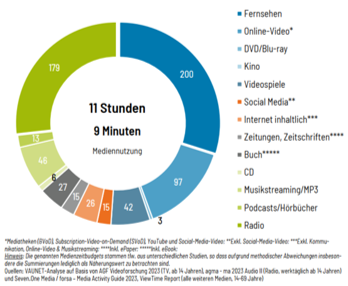 Figure 1: Average daily media time budget of Germans in 2023; Source: VAUNET [4]
Looking at current audience market shares, the public broadcasting channels ZDF, the regional third channels, and ARD dominate with a market share of over 50 percent. The remaining relevant market shares are divided between the channels of the Bertelsmann Group and ProSiebenSat1 MEDIA SE. [5]
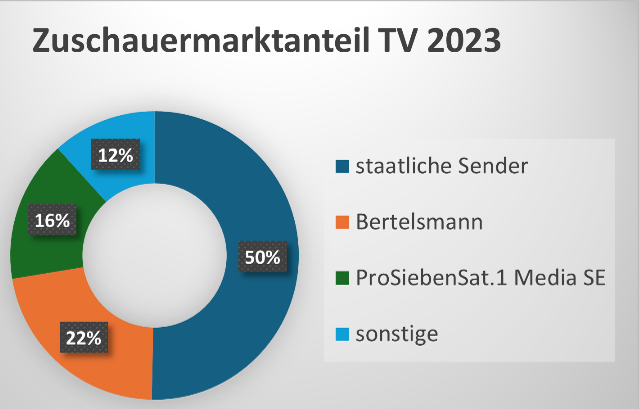 Figure 2: TV audience market share 2023 in Germany
The second most popular medium in Germany remains radio. Even though the market is slowly diversifying with the emergence of digital music and podcast streaming services, it remains an essential component of the German media offering. Here too, the public broadcasting stations have the largest market share.
The total circulation of daily newspapers in Germany has continuously fallen by more than half over the past 30 years despite a positive trend in digital editions and stood at only 12.3 million copies in 2022. Nevertheless, print media remain an important source of information for many people. By far the highest-circulation national daily newspaper in Germany is the Bild newspaper. The tabloid belonging to the Axel Springer publishing house had with approximately one million copies the highest circulation among national daily newspapers in Germany in the second quarter of 2024. Second is the Süddeutsche Zeitung with around 250,000 and third is the Handelsblatt with almost 200,000 copies. [6]
Remarkably, the most important German medium — television — is dominated by exactly three centralized institutions. Looking also at the 2023 ranking by the Cologne Institute for Media and Communication Policy on the ten largest media conglomerates in Germany [7], it becomes clear that the Bertelsmann Group as number one generates more revenue than the five subsequent conglomerates combined.
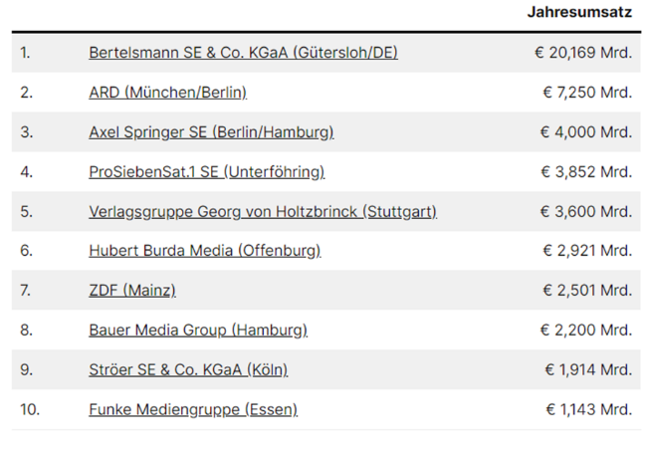 Figure 3: The ten largest German media conglomerates 2023 by annual revenue; Source: mediadb.eu [7]
In the ranking of the world’s largest media and knowledge conglomerates, it occupies position 18 and is thus a company of global significance.
The Bertelsmann Empire [8]
There are now numerous articles and books about the influence and reach of the Bertelsmann publishing house. To understand how a single conglomerate could attain such power, we need to look at its history.
The Bertelsmann publishing house was founded in 1835 in the small town of Gütersloh by the bookbinder and printer Carl Bertelsmann. His Christian-conservative basic attitude shaped the beginnings of the new publishing house with books, magazines, and newspapers. Bertelsmann produced popular and populist content and relied from early on on mass markets and efficient mass distribution of its products. The early Christian books were not aimed at individual readers in bookshops but were sold to Christian associations, churches, poorhouses, schools, and educational institutions. With the death of publisher Heinrich Bertelsmann in 1887, the Bertelsmann family line died out. Heinrich left no sons, only one daughter, Friederike Bertelsmann. She married the pastor’s son Johannes Mohn, who later took over the Bertelsmann publishing house. His family name has remained closely associated with Bertelsmann to this day.
In mid-2021, Bertelsmann spokesperson Liz Mohn handed over her position to her son Christoph Mohn. Since then, the Bertelsmann Group has been a family business in the sixth generation of the Mohn family.
Under the family’s leadership, the publishing house repeatedly managed in the 20th century to support the prevailing political ideology of the time through the publication of propaganda literature. Thus the publishing house entered a symbiotic relationship with the Nazi regime and produced special book series for the German Wehrmacht. Among the numerous German publishers that during the war supplied around 18 million German soldiers and members of the Waffen-SS with entertainment and reading material, Bertelsmann led with 19 million books for this target group alone.
True to the motto: “If you can’t swim against the current, then swim with it,” Heinrich Mohn quickly arranged himself with the American occupiers after the war. Politically opportunistically, he printed in 1946 the new laws of the American occupying government and new school textbooks approved by the Allies. The total print run was 140,000 copies. After 1945, Bertelsmann expanded parallel to the general economic upturn in the Federal Republic and soon became one of the largest publishing houses in the country. In the 1960s, the company extended its activities to European countries and by the 1970s was already the largest German media conglomerate with 80 companies and an annual revenue of 2.4 billion DM.
With the emergence of commercial television in the 1980s, Bertelsmann invested massively in this new entertainment industry and grew by the 1990s to become the world’s second-largest media conglomerate, with around 350 direct subsidiaries and approximately 45,000 employees in Central and Eastern Europe.
The success story in the second half of the 20th century also went hand in hand with a symbiotic business relationship with the current political leadership in Germany. Thus communications scholar Peter Glotz was managing director of the Social Democratic Party of Germany (SPD) from 1981 to 1987, and former SPD Federal Finance Minister Manfred Lahnstein served on the board and supervisory board of Bertelsmann from 1983 to 2004. Even at the beginning of the new millennium, under the new Chancellor Angela Merkel of the CDU, the direct line to the political elite was maintained through the personal friendship between Liz Mohn and the then Chancellor.
Looking at the success story of the Bertelsmann publishing house, one can clearly recognize that the Mohn family was never at any point concerned with political integrity. Like a flag in the wind, they pursued their own goal of always seeking political proximity to the ruling class at the time and were consistently and unprincipledly willing to conduct political propaganda and support the respective agenda. All in the name of their own success and influence. With this strategy, the conglomerate successfully developed into one of the largest and most influential media giants in the world. And as we shall see, nothing about this success philosophy has changed to this day.
In 2020, Bertelsmann held stakes in 67 television channels, 10 streaming services, 38 radio stations, global production companies, and a digital video network, as well as in more than 300 book publishers on six continents. [9] The conglomerate today is organized into seven independent business divisions. These include the RTL Group, BMG Rights Management (BMG), the Bertelsmann Education Group, the Bertelsmann Printing Group, and Bertelsmann Investments. The Bertelsmann Group also includes the services company Arvato with more than 65,000 employees worldwide, and since 2020 the world’s largest book publishing group by revenue, Penguin Random House.
This controls a quarter of the global book market. At the beginning of 2022, the international publishing group Gruner + Jahr (G+J) was added to the RTL Group. Furthermore, with Fremantle, one of the world’s largest developers, producers, and distributors of fictional and non-fictional media content, producer of soap operas and game shows (e.g., American Gods, American Idol, America’s Got Talent) as well as streaming services (e.g., over 300 YouTube channels) belongs to the RTL Group’s portfolio.
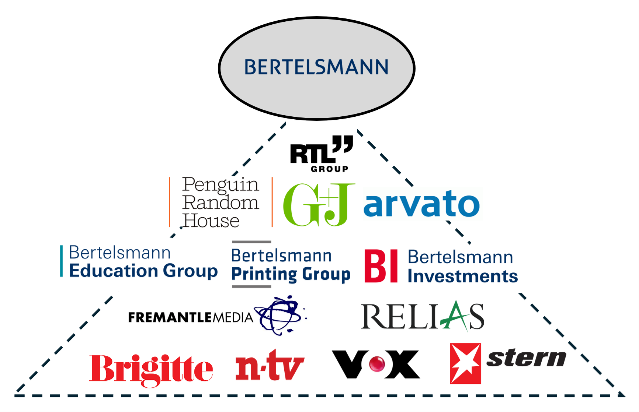 Figure 4: Overview of the largest companies in the Bertelsmann Group
Bertelsmann also now cooperates with other major players in the digital technology market, such as through the partnership with Microsoft to expand its e-learning portfolio. [10] Relias, Bertelsmann’s e-learning provider, builds its platform on Microsoft’s Azure Cloud technology. Bertelsmann and Microsoft also plan to develop a series of highly scalable platforms for delivering personalized content from news to entertainment to education. The first project “BeData,” a platform for analyzing and using consumer data for the production of personalized content and advertising, is already being used by the streaming service RTL+.
The Bertelsmann Foundation
In 1977, Reinhard Mohn also founded the Bertelsmann Foundation, which has since become the main shareholder of the Bertelsmann Group. The official statutes state, quote:
“The establishment of the Bertelsmann Foundation in 1977 was based on the conviction of its founder that the consequences of the emerging global system competition were not being sufficiently heeded in our country. The Bertelsmann Foundation was therefore to concentrate on developing solutions to problems in the most diverse areas of our society while serving the systemic advancement of politics, economy, and society. The inclusion of foreign insights and a balanced relationship between scientific and practical experience were to be observed.” [11]
In the public congratulatory message for the Foundation’s 40th anniversary in 2017 [12], the indicted war criminal Henry Kissinger expressed his delight at the shared work since the Foundation’s beginnings; Ursula von der Leyen — the current President of the European Commission — thanked the Foundation for its accompaniment over the past four positions; Christine Lagarde — the current President of the European Central Bank (ECB) — noted that the Foundation had proven itself a very valuable partner over the past 40 years; Klaus Schwab compared the Foundation with his World Economic Forum; and at the end, the then Federal President Frank-Walter Steinmeier closed the speeches of thanks: ”…If the Bertelsmann Foundation did not exist, we would urgently have to invent it.”
With the founding of the Bertelsmann Foundation, the Mohn family elevated their traditionally close cooperation with the ruling political class to a new level. Although the Foundation and the Bertelsmann Group are formally two separate entities, they are closely intertwined and both controlled by the Mohn family. As one of the most influential and best-connected neoliberal think tanks in Germany, the Foundation today serves as a link between the conglomerate and the state.
Its projects focus on the areas of education, schools and universities, health policy, demographic development, labor and social policy, as well as foreign and security policy. There is hardly a topic in Germany in which the Foundation is not involved. Thus the experts of the Foundation and the company act as a powerful global mouthpiece for their friends in politics, to effectively guide public opinion, implement laws and reforms, and preserve their own influence. [13]
An independent and neutral reporting from the Bertelsmann house on the prevailing political agenda and its representatives simply cannot be expected given the facts presented here. Even less so on the entire political system as such. One simply does not saw at the branch on which one sits so comfortably.
Public Broadcasting
One might think that despite this extreme concentration of German media in private conglomerates like Bertelsmann or Axel Springer, the individual formats and editors of the public broadcasting channels can work freely and offer German citizens the often-promised independence and diversity of opinion.
First, it must be noted that public broadcasting in Germany is compulsorily financed by the population through the legally mandated broadcasting fee. It makes no difference whether the individual citizen wishes to use this service or appreciates the work of public broadcasting. Every household is obligated under threat of penalty to pay this fee. [14]
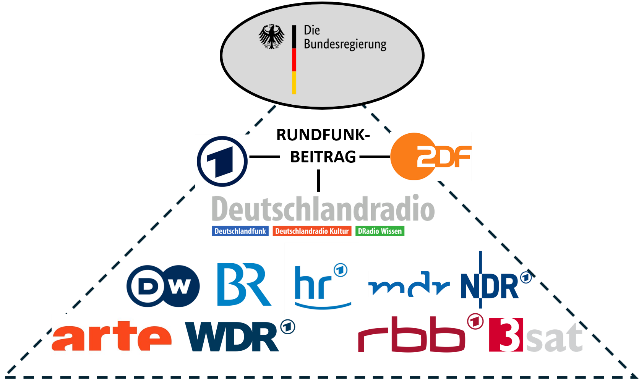 Figure 5: Overview of the largest public broadcasting institutions
The public broadcasting institutions in Germany are furthermore subject to the so-called ‘public broadcasting mandate’ [14]. This mandate is enshrined in law and encompasses several central points, such as ensuring comprehensive basic provision of the population with information, education, culture, and entertainment. Furthermore, the public broadcasters are to operate independently of state influence, which however does not apply to their direct funding. They are to promote diversity of opinion and contribute to free individual and public opinion formation.
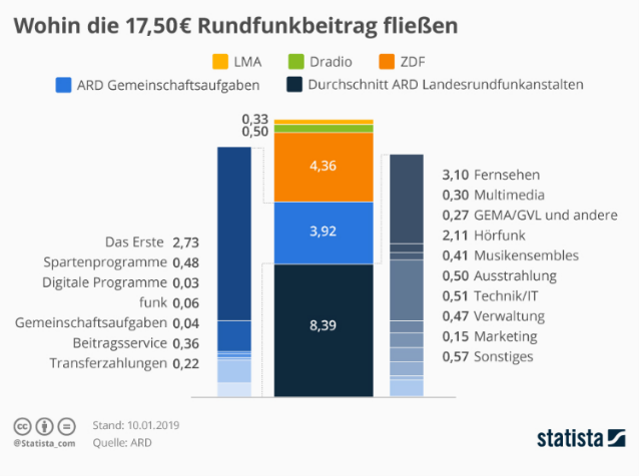 Figure 6: Distribution of the legally compulsorily funded broadcasting fee from 2019
Nevertheless, the public broadcasting stations have been facing increasingly fierce criticism in recent years. Many critics argue that public broadcasting institutions funded by the state cannot report independently of the state. According to the ‘State of the Media Report’ by Cision, in which around 250 German media professionals were surveyed about public trust in the media, approximately two-thirds of respondents stated in 2023 that trust had declined. [15]
More and more people in Germany believe that the public broadcasting stations are under censorship and function as a mouthpiece of the German government. But what is the truth of the accusation of state television? Let us take a closer look at three case studies from recent years:
Case Study 1: Die Anstalt and the Federal Court of Justice (2014)
In 2014, the ZDF cabaret show “Die Anstalt” exposed various interlinkings of major German media houses with transatlantic lobbying organizations. The editor of the weekly newspaper “Die Zeit,” Josef Joffe, and the “Welt” journalist Jochen Bittner subsequently filed for injunctions against the ZDF satirical show, whereupon the channel removed the episode from its media library. They ultimately failed before the Federal Court of Justice, as — quote: “The statements regarding conflicts of interest due to uncontested memberships in lobbying organizations are correct in principle.” [16] The segment nevertheless remains deleted from ZDF and the transatlantic connections are not further investigated.
Case Study 2: MDR Umschau and the Deleted Vaccination Report (2023)
In December 2023, the MDR format Umschau published critical reporting on the Covid vaccines with the title: “Covid Vaccine Under Criticism. What’s Behind It?” That same month, the segment was deleted from the media library under pressure from MDR management. The participating editors were accused of having violated journalistic due diligence. In the subsequent months, the participating authors and editors were publicly pilloried and had to endure labor law proceedings. In June 2024, the MDR program committee concluded after numerous sessions that all journalistic quality standards had been adhered to in the segment. The broadcasting council of MDR therefore draws no consequences. The segment here too remains deleted. [17]
Case Study 3: The Manifesto for Diversity of Opinion (2024)
In April 2024, a group of employees of public broadcasting published a manifesto for a reform of their own employer. [18]
In this manifesto, it states, quote:
”…For some time we have been observing a narrowing of the debate space instead of an expansion of perspectives. We miss the focus on our core task: offering citizens multi-perspective information. Instead, opinion-making and reporting are increasingly blurring in a way that contradicts the principles of serious journalism. Very rarely do relevant substantive discussions with contrary opinions take place. Voices that question a — media-asserted — social consensus are variously ignored, ridiculed, or even excluded. Various ‘fighting terms’ are used to this end, such as ‘lateral thinker,’ ‘conspiracy theorist,’ ‘climate denier,’ ‘Putin-understander,’ ‘pacifist of conviction,’ and others, with which minorities with dissenting opinions are sought to be defamed and silenced.
Internal press freedom currently does not exist in the editorial offices. The editors at the public media are formally independent; mostly there are also editorial committees that are supposed to watch over journalistic independence. In practice, however, the public media orient themselves to the opinion spectrum of the political-parliamentary majority. Dissenting voices from civil society rarely make it into the debate space…” [18]
One of the authors of this open manifesto, which has since been signed by over 100 colleagues, is the journalist Ole Skambaks. The former SWR editor was dismissed in autumn 2021 after public criticism of SWR’s biased and government-loyal handling of Corona. [19]
Many other signatories of the manifesto were similarly dismissed after public criticism of their employer or had to endure disciplinary measures. Another example is Thomas Moser. Moser has worked for 35 years as a freelance radio journalist for the ARD institutions. In April 2024, he also published a report on the Covid pandemic with the title “Greatest Journalistic Failure Since the Founding of Public Broadcasting.” [20]
In it he writes:
“Without the media, the Corona regime could not have established itself in spring 2020. Instead of critically questioning the dubious political virus ordinances, they were propagandistically carried along. In one ARD institution, the order came from above: ‘The Corona measures are not to be questioned.’ The public media — ARD, Deutschlandfunk, and ZDF — were given a special role due to their standing. In fact, the media sealed off the Corona regime and, from 2022 onwards, the German war course in the Russia-Ukraine War against real public discourse. No uncomfortable questions get through anymore, no contradiction, no alternative perspectives. Like the governments, they too have abused the trust of many people in their correctness.”
The trained political scientist, sociologist, and ethnologist also engaged in the past with the NSU trial and published various books on it. [21] In the course of his criticism, he was also removed from the author pool of a critical radio magazine of WDR.
These few examples show how massively public broadcasting acts against journalists who do not correspond to the prevailing narrative. A German journalist under contract with public broadcasting institutions or other major media conglomerates may exercise their free journalistic work as long as they do not leave the opinion corridor prescribed from above. Should an engaged journalist once work too independently, they are censored, discredited, and may lose their job and reputation entirely.
The Fourth Estate
Looking at the information before us, the differences between public broadcasting and a media empire like Bertelsmann are secondary. For diversity of opinion and freedom of expression, it is irrelevant whether the opinion corridor prescribed by the top decision-makers is compulsorily financed by a broadcasting fee or earned through corporatism with the political elite.
What is decisive is the concentration of media in centralized institutions and the resulting editorial dependencies and power dynamics. It is self-evident that the Mohn family and the other shareholders possess with the media mouthpiece Bertelsmann a powerful weapon for influencing and shaping public opinion. Equally, it is naive to believe that the public media conglomerates represent the broad opinion of the people. Every state too has corporate-like structures and acts on behalf of the decision-makers in the respective positions of power. These people — or above all these people — are primarily interested in their own careers and follow the prescribed narrative of the next higher level.
The ordinary observer might now be inclined to believe that at least the major private conglomerates and the public institutions represent different opinions. When it comes to the prescribed political left-liberal to right-conservative opinion corridor or fringe topics at the local level, this may be true. But if one looks more closely at the internal structures and the shared partnerships, foundations, and projects, it quickly becomes clear that at the decisive issues they sit at the same table.
Let us consider the connections between the Bertelsmann Group, the public broadcasting institutions, and the German federal government. First of all, there are some direct interactions through shareholdings, productions, and cooperations in the media landscape. Which should not be further surprising and is quite normal in this industry. Much more interesting and meaningful, however, are the shared connections and projects through the many foundations and non-profit organizations.
The socio-political mouthpiece of the Mohn family, the Bertelsmann Foundation, has for example some sister and subsidiary organizations. These include the CHE Center for Higher Education Development. Here the Foundation works together with the German Rectors’ Conference (HRK), the voluntary association of public and publicly recognized universities in Germany. The CHE describes itself as — quote: “We have understood ourselves since our founding as an independent, implementation-oriented, and internationally aligned think tank. The main focus is on the German and European higher education sector. We provide food for thought, stimulate innovation, and reflect reform results.” [22] The CHE is known for its university ranking, research projects, and consulting services, which play a significant role in the development and reform of the higher education system.
Another of these subsidiaries is PHINEO, a key organization in the German non-profit sector, which — quote: “…thinks about new ways of philanthropy and investing to strengthen strategic and social engagement.” [23] PHINEO awards its own seal to non-profit organizations and projects. This distinction serves according to its own standards as a quality mark and is intended to help donors, foundations, and investors identify trustworthy projects. PHINEO has been funded since 2017 by the Federal Ministry for Family Affairs, Senior Citizens, Women and Youth. [23]
Bertelsmann is also part of the sponsoring circle and stands in project partnership with the German Council on Foreign Relations. This forum was founded in 1955 by various German politicians and is committed to a sustainable German and European foreign and security policy oriented toward democracy, peace, and the rule of law. This forum is largely funded by federal subsidies and funding from the Foreign Office and the Federal Ministry of Defence. [24]
Bertelsmann also maintains a strategic partnership with the World Economic Forum (WEF). [25] The cooperation encompasses various initiatives and areas. Furthermore, Bertelsmann is regularly represented at the annual WEF meetings in Davos, where leading figures from business, politics, science, and society discuss their shared agenda for humanity. [26] In 2017, Klaus Schwab, the founder of the WEF, was also honored with the Reinhard Mohn Prize. [27] With this prize, the Bertelsmann Foundation annually honors internationally renowned personalities who have distinguished themselves through pioneering solutions to social and political challenges. In 2024, with Economics Minister and Vice Chancellor Habeck, Foreign Minister Baerbock, Finance Minister Lindner, and Research Minister Stark-Watzinger, the German federal government sat at the same tables at the WEF in Davos. [28]
We could present further institutions, connections, and shared projects and will deepen and expand this in one of the upcoming agorist analyses. To understand the power structures in the media industry, the analysis so far should however make the overall picture recognizable. Major conglomerates and governments are interwoven in a dense network of non-profit organizations, foundations, projects, and philanthropic think tanks. If one traces these power structures in both cases up to the top, one ends up at the same tables.
And this is by no means a purely German phenomenon or explicit criticism of the German media institutions. We find the same power structures, connections, and projects in Russia, China, the USA, or elsewhere in the world. It should upon closer inspection also not be surprising that the media institutions compulsorily financed through state legislation act on behalf of and in the interest of their financier. [14] It is often falsely claimed that the people are the financiers of the public media institutions in Germany. Thus the media would also act in the interest of the people — their financier. However, the coercion and duress in the financing changes everything. The government does not ask its citizens — it orders. That is a decisive detail; that is the difference between love and rape.
The media are therefore also often referred to as the ‘Fourth Estate.’ A derived expression from the traditional European concept of the three estates: the clergy, the nobility, and the citizens. The Fourth Estate represents the ‘fourth power’ with the press and media, which possess the ability to advocate for and shape political issues.
In the book Manufacturing Consent [29], linguists Noam Chomsky and Edward S. Herman argue that the mass media tend to support the interests of the economic and political elites and to influence the public in their interest. Through the application of the propaganda model, Herman and Chomsky show how news is selectively filtered and presented to promote certain ideologies and marginalize dissenting opinions.
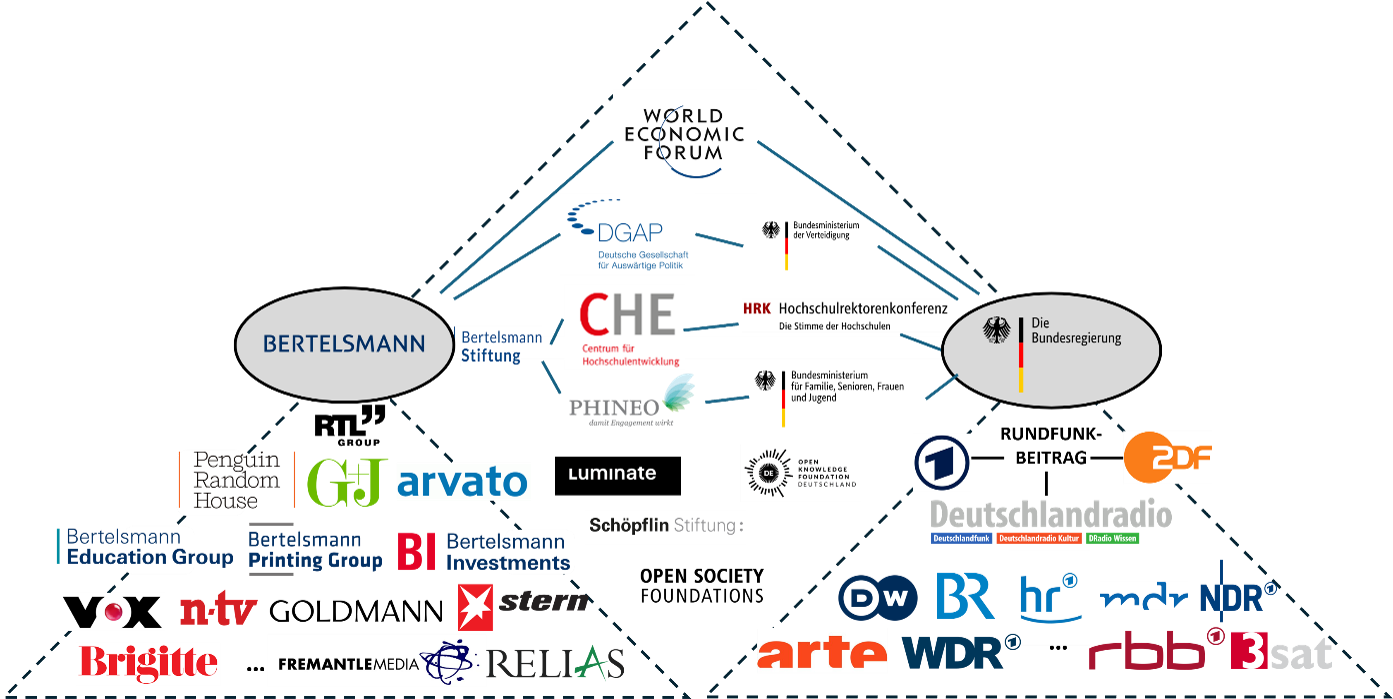 Figure 7: Organizational chart of the investigated connections and organizations
In the 2002 introduction to the book, they write:
“The media serve and propagate, on behalf of the powerful societal interests that finance and control them. The representatives of these interests want to advance important agendas and principles and are very well positioned to shape and constrain media policy.”
Chomsky describes the various methods by which media in interplay with politics are used to influence public opinion:
- Distraction
- Gradualism
- Deferring actions to a later date at which the public will presumably react more agreeably
- Speaking to the public as if to a child
- Stoking the viewer’s emotions
- Keeping the public ignorant
- Promoting trends
- Making the public responsible for problems
- With the understanding of underlying mass psychology
For every single one of these points, there are also abundant case studies in the German media landscape.
In Orwell’s dystopian novel 1984 [30], the totalitarian government invents a constant threat from external enemies and revolutionaries to keep the population in fear and justify its control. These enemies are often fictitious or greatly exaggerated, and the threat is used to consolidate the power of the state. Even though this is a fictional novel, the methods described are quite applicable to reality.
Research shows that fear is a powerful tool for controlling and manipulating people. [31][32][33] Fear impairs cognitive processing, increases the willingness to submit to authority, and can be deliberately deployed through political and social structures to control the population.
Through the leaked documents of Edward Snowden, we now also know that the rulers of this world are aware of these facts. [34] According to one of the published documents of the well-known whistleblower, the British government for example maintains software for “online self-management.” The British Government Communications Headquarters (GCHQ) operates an elite unit known as the ‘Joint Threat Research Intelligence Group (JTRIG).’ The documents outline tactics that were applied by the agency, including ways to manipulate public opinion, understand human thinking and behavior, and promote conformity.
One of the reports from 2011 describes tactics of the agency, including uploading YouTube videos with “convincing communication,” founding Facebook groups and Twitter accounts, creating fake online personalities and supporters to “discredit, promote distrust, discourage, deter, delay, or disrupt.” The unit used social media campaigns to promote and support “obedience” and “conformity.”
The British psychologist, author, filmmaker, and YouTuber Ralph Smart, also known as ‘Infinite Waters,’ puts it in one of his videos [35] as follows:
“We are sold a seemingly real illusion the moment we follow mass media and politics. Our society aims for the majority of people to act on the basis of fear. People in these lower frequencies are less self-aware and easier to control and manipulate. That is precisely why bad news awaits you when you consume media in the morning. It is about the manifestation of these lower vibrations and emotions in society. Think about it the next time you glance at the news. The bad news will already be waiting for you.”
Solutions
Turning off the television, canceling subscriptions, and simply consuming no more media is the simplest and most obvious solution. Even though it is highly recommended for one’s own well-being to reduce media consumption to a minimum, most people have a fundamental need to stay informed about the world around them. Fortunately, due to the permanent failure and obvious bias of the established media, there are increasingly more alternative media projects in the German-speaking world.
The Internet has fostered a growing ecosystem of alternative media with websites, channels, podcasts, and journalists. Unfortunately, the decentralized nature of the Internet has been given up in favor of centralized institutions that offer search engines, social media, and other Internet services. The majority of the public uses Google, Facebook, and YouTube to inform themselves about the world. These people falsely believe that they are comprehensively and well-informed. As we will see in one of the upcoming analyses on Big Tech, this is far from the truth.
But here too there is remedy with a number of alternative social media and video platforms that offer users an uncensored and unfiltered experience. Sites like Odysee, Bitchute, LBRY, Minds, Flote, and Hive offer creators of value the option to present their own truth.
This does not mean, however, that these media have no opinion or are uninfluenced. There simply is no neutral reporting. All media creators act from their own standpoint and in so doing, their own truth and their own worldview will always influence the content. It is more about the basic assumption that the viewer is trusted to consume content from a broad spectrum of perspectives and viewpoints and form their own opinion. This is the only true definition of independence and diversity of opinion.
More fundamentally, it is about understanding the current media offering and the inherent power dynamics and mechanisms. Every media creator pursues a goal with their work. And that is first and foremost the confirmation of their own worldview.
A state media institution will not promote a state-critical worldview, at least not when it concerns its own state. A convinced political left- or right-leaning media creator will not expose the logical errors inherent to their own political narrative, but will only apply this method of working to the opposing side. An agorist-anarchist platform — like ours — will similarly attempt to bring this worldview closer to the reader. The moment one receives news from a third-party source, one should always be aware of the unavoidable human filter of the media creator.
If one harbors interest in largely independent and honest reporting on the prevailing power structures in politics and big capital, then one should not look for this information from media institutions that are in any way promoted, supported, or financed by powerful, political, and financially strong institutions.
The answer is to open one’s eyes to existing realities. The media creators in the public media and the major conglomerates work together like a well-oiled machine to continue dividing the broad mass of the population with the help of the existing political left-right dogmas, war, and further hostile programming, keeping them in constant fear and distracting them from the essential things. These mechanisms in turn help the rulers of this world to push through their agenda and maintain and expand their power and influence. This requires no conspiracy. Most media creators consciously or unconsciously support this system and see themselves, due to their own conditioning, on the right side.
The answer for each of us is to make a conscious decision and disengage from the state-organized propaganda networks and online platforms that attempt to filter the opinion spectrum and sell a pre-fabricated worldview. The answer is to support independent media and journalists who do the necessary work of analyzing the world around us and empowering and educating the public. The answer is to conduct one’s own research and to inform oneself about important things through primary sources.
No state, major conglomerate, or non-profit institution of fact-checkers possesses a monopoly on the truth. Additionally, one should understand that in all of human history known to us, all the empires, dictatorships, and democracies have censored only the truth. Furthermore, this censorship was always anchored in the motivation to maintain and expand one’s own power.
“Without freedom of speech no search for truth is possible; without freedom of speech no discovery of truth is useful; without freedom of speech, progress is checked and the nations no longer march forward toward the nobler life which the future holds for man. Better a thousandfold abuse of free speech than denial of free speech. The abuse dies in a day, but the denial slays the life of the people, and entombs the hope of the race.”
— Charles Bradlaugh
To learn more about the control and manipulation of the media in Germany and the world, we recommend reading the following books:
- Bertelsmann: A Transnational Media Service Giant [1]
- Manufacturing Consent [29]
- The Psychology of Crowds [36]
We also recommend watching the second chapter of Derrick Broze’s documentary series The Pyramid of Power [37].
References
- J. B. Mandy Tröger, Bertelsmann: A Transnational Media Service Giant (Global Media Giants), 2022.
- LEMO. dhm.de/lemo – Universum Film AG (UFA). Accessed September 2024.
- Axel Springer Verlag. axelspringer.com – History/Chronicle.
- VAUNET. VAUNET Media Use Analysis 2023, 2024.
- AGF Videoforschung. AGF SCOPE 1.4; 01.01.2023–31.12.2023; Market Standard: TV, 2024.
- STATISTA. Ranking of the highest-circulation national daily newspapers in Germany in Q2 2024, 2024.
- Institute for Media and Communication Policy. mediadb.eu – The ten largest German media conglomerates 2023. September 2024.
- Bertelsmann. history.bertelsmann.com. Accessed 2024.
- Bertelsmann. Bertelsmann Annual Report 2021/2022, 2022.
- Microsoft. news.microsoft.com – Bertelsmann and Microsoft intensify partnership. November 10, 2021.
- Bertelsmann Foundation. Statutes of the Bertelsmann Foundation. Accessed 2024.
- Bertelsmann Foundation. YouTube – 40 years Bertelsmann Foundation – Greetings from around the world. Accessed 2024.
- T. Schuler. Bertelsmannrepublik Deutschland: Eine Stiftung macht Politik. Campus Verlag, 2010.
- Broadcasting Fee State Treaty. rundfunkbeitrag.de. Accessed 2024.
- Cision – State of the Media Report 2023. statista.com – Trust in media in Germany. Accessed 2024.
- Press release of the Federal Court of Justice. juris.bundesgerichtshof.de. 2017.
- B. S. and D. Korbely. freie-medienakademie.de – Medien Plus 142. Accessed 2024.
- O. S. and colleagues. meinungsvielfalt.jetzt/manifest.html. Accessed 2024.
- Frankfurter Allgemeine Zeitung. faz.net – SWR and dismissed employee Ole Skambraks reach settlement. 2022.
- T. Moser. overton-magazin.de – Corona reporting is the greatest journalistic failure. 2024.
- T. Moser. Der Amri-Komplex. Westend Verlag.
- CHE Centre for Higher Education Development. che.de – About us. Accessed 2024.
- PHINEO. PHINEO Annual Report 2022, 2023. phineo.org – Who we are.
- DGAP. dgap.org – The history of the DGAP. Accessed 2024.
- World Economic Forum. weforum.org – Bertelsmann Foundation. Accessed 2024.
- Bertelsmann Foundation. bertelsmann-stiftung.de – WEF Workshop. Accessed 2024.
- Bertelsmann Foundation. Prof. Klaus Schwab receives the Reinhard Mohn Prize. Accessed 2024.
- Federal Government. bundesregierung.de – World Economic Forum Davos. Accessed 2024.
- E. S. Herman and N. Chomsky. Manufacturing Consent: The Political Economy of the Mass Media. Pantheon, 2002.
- G. Orwell. 1984 – Nineteen Eighty-Four. 1949.
- J. F. Thayer, F. Ahs, and M. Frederikson. “A meta-analysis of heart rate variability and neuroimaging studies.” Neuroscience & Biobehavioral Reviews, Volume 36, Issue 2, 2012.
- R. C. McIntosh, H. Rosangela, and J. S. Nomi. “Neurovisceral integration in the executive control network.” Biological Psychology, Volume 157, 2020.
- R. Neuman, G. E. Marcus, and A. N. Crigler. The Affect Effect, 2007.
- A. West. theworld.org – 17 disturbing things Snowden has taught us so far. 2016.
- I. Waters (Infinite Waters). YouTube – What Is The Matrix? How To Break Free. 2023.
- G. Le Bon. The Psychology of Crowds, 1895.
- D. Broze. thepyramidofpower.net – Establishment Media.
- PHINEO. phineo.org – Who we are.