Propaganda Through the Ages
From ancient Rome to modern social media: how propaganda has changed over millennia — and what remains constant about its methods and goals.
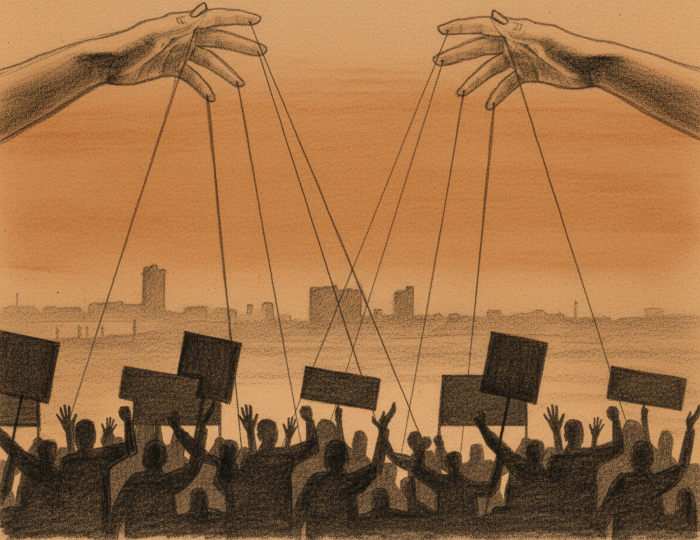
Looking back at human history, the term propaganda was first used in 1622 in the context of the Catholic Counter-Reformation. The practices associated with it, however, are far older than the term itself. Viewed from a time- and place-independent perspective, this term describes all techniques that support and legitimize the permanent claim to power and control of an external authority. In doing so, the perception of the target group is influenced and manipulated in the direction of this worldview, so that they regard the institutional claim to power over their lives as unavoidable and justified.
Propaganda as a Permanent Functional Condition
Propaganda is thus not a historical exception but a permanent functional condition of modern power structures. It describes the necessity of every organized religion or government. From the perspective of natural law, propaganda presents the oppressive and immoral power relations as an indispensable tool of apparently modern societies.
Propaganda is also not exclusively a crude instrument of authoritarian regimes. Its true nature lies in its constant adaptability and expediency. This expediency ends only through the overcoming of a socially accepted external authority. The ruling class will always sell their claim to power as a necessary evil for a civilized society. What “civilized society” means in this context we have laid out in a separate article.
Industrialization
Industrialization in the 19th and 20th centuries brought significant structural changes. Millions of people moved from rural regions to the cities, where they lived concentrated in space and socially heterogeneous. This anonymous and interchangeable mass society was no longer based on the traditional social bonding structures of agrarian societies. In rural societies, people lived most of their lives in the same village or the same region. One knew one’s neighbors and risked exclusion and loss of reputation for deviation from social norms. This social pressure was much lower in the anonymous mass society of the city. Authority therefore had to be switched from personal loyalty to collective perception management.
At the same time, industrial mass communication developed through radio, television, and mass newspapers. While communication was previously locally limited, millions of people could now be reached simultaneously. Industrialization created with mass production, mass media, and anonymous mass societies the structural prerequisites for modern perception management.
Public Relations
In fact, the insights of mass psychology in the 20th century significantly expanded the research field of propaganda for governments, militaries, and later also corporations. New scientific theories about group behavior, emotions, authority, and collective perception professionalized the conscious manipulation of the organized habits and opinions of the masses.
The two world wars mark a decisive turning point in the application and perception of propaganda. An estimated 100 million people lost their lives through direct consequences of war or indirectly through hunger, disease, or displacement. Accordingly, the number of those who experienced traumatic and painful experiences during this formative time is many times higher. The peoples of all participating alliances were drenched in state propaganda. An unprecedented, systematic alignment and continuous media bombardment filled the public perception of that time with hatred, fear, and division.
This open brainwashing was so painful and memorable in its ultimate consequence that the term propaganda and the associated practices were inseparably negatively tainted in public discourse. The public awareness looked deep into the totalitarian face of state power structures through collective pain. As a result, as during the peasant protests of the Reformation era, there were increased countermovements with numerous autonomous and state-critical currents. These interpreted the exaggerated state faith, nationalism, and obedience to authority as central causes of the catastrophes of the 20th century. Among the well-known names of these currents are Emma Goldman, Hannah Arendt, and Albert Camus.
“It is irrelevant whether a government invokes a God-given right or the will of a majority. The goal is always the absolute submission of the individual.”
[Emma Goldman]
Consequently, propaganda as a means of manipulative influencing of social perception had to be wrapped in a new guise in order to continue legitimizing the existing power structures. This new guise was popularized worldwide in the 1920s through the work of Edward Bernays as public relations. Although he was neither the first nor the only public figure who coined this term, his work and reach allow us to trace the development of that era well. Bernays was the nephew of Sigmund Freud and belonged to the new influential technocratic educated elite of that time. He was excellently informed about the workings of mass psychology and gathered valuable practical experience during World War I as a representative of the American war propaganda agency (U.S. Committee on Public Information). This is not to say, however, that Bernays and his associates were aware of their role. Rather, they acted as products of the prevailing worldview, shaped by moral selectivism, elite thinking, and an exogenous way of life.
This is clearly traceable in the case of Edward Bernays through his book published in 1928 with the fitting title ‘Propaganda’. He is considered one of the most important pioneers of modern state and economic manipulation and control techniques. Following are some lines from his book that illustrate his motivation and standpoint:
“The conscious and intelligent manipulation of the organized habits and opinions of the masses is an important element in a democratic society. Those who manipulate this mechanism constitute an invisible government and are the true ruling power in our country.” [p. 9]
“In the past, those with power were leaders. They set the course of history by doing what they wanted. If today’s successors of the rulers — those who have power by virtue of their position or abilities — can no longer do what they want without obtaining the consent of the masses, then they find in propaganda an ever more powerful instrument to obtain this consent. Therefore, propaganda is here to stay.” [p. 27]
“Due to the increasing complexity of modern life and the resulting necessity of making the actions of one part of the public understandable to other parts of the public, the new profession of public relations has emerged. It is also due to the increasing dependence of organized power of all kinds on public opinion. Governments — whether monarchical, constitutional, democratic, or communist — depend on the approval of the public for the success of their efforts. Indeed, a government exists only because of the consent of the public.” [p. 37]
“A propagandist must understand the true motives and must not content themselves with accepting the reasons that people give for their actions. It is not enough to understand only the mechanical structure of society, the groupings, divisions, and loyalties. An engineer may know everything about the cylinders and pistons of a locomotive, but if he doesn’t know how steam behaves under pressure, he cannot make his machine run. Human desires are the steam that drives the social machine. Only when the propagandist understands them can he control this vast, loosely connected mechanism that constitutes modern society.” [p. 52]
Bernays was convinced that the ordinary person was too uneducated to make their own decisions. Therefore, a self-proclaimed intellectual elite would have to lead and direct the public through manipulation. He justified this immoral claim to power with ethical basic principles. What exactly this meant is revealed, for example, by the analysis of his collaboration with the United Fruit Company and the violent coup in Guatemala. This successful PR strategy resulted in a years-long civil war in which mainly indigenous people died.
Bernays and his associates transformed the worn-out propaganda structures from an openly and self-confidently acting state model into a system that acts more subtly and appears democratic. In doing so, he wrapped the means necessary for controlling and manipulating the population in a new, more efficient guise. His greatest innovation was the shift from pure political propaganda to universal social opinion management. He was one of the first visionaries of his time to recognize that it is more efficient to apply propaganda techniques in an overall societal context rather than steering the masses solely through state and institutionally organized propaganda. Public relations thus became an economic strategy, a government communication tool, and a cultural management instrument. People who direct their attention outward in an exogenous mode of existence and who are oriented toward consumption, status, and prestige are easier to steer and control. Common means of manipulation for him were the staging of authority, emotional symbolic politics, or the control of the media. These techniques continue to shape the modern world of power and capital to this day.
He also diluted propaganda as a concept by using it for any organized effort to spread a particular doctrine. He correctly recognized that the techniques for manipulating human consciousness can be applied in all areas of societal relevance. And of course, the societal power structures are also inseparably linked to the financial system or the educational system. However, there is a crucial difference between voluntariness and coercion. One can apply manipulative techniques to sell a particular product for personal enrichment. One can apply the same manipulative techniques to the same target group to legitimize a particular social power structure for the personal enrichment of a ruling class. In the first example, the target group has the choice of consuming the product. In the second example, the loyalty of the target group is enforced with violence and coercion in an emergency. So one can advertise all possible ideas with propaganda techniques, but only propagandize authoritarian power structures. Unfortunately, this crucial distinction was lost in the public perception of propaganda through these new developments around public relations.
Think Tanks as a Necessary Link
Another noteworthy aspect in the further development of institutional control mechanisms for maintaining existing power relations is the global emergence of so-called think tanks. Historical examples include the Council on Foreign Relations (founded 1921, USA), the Royal Institute of International Affairs (1920, Great Britain), or the Stiftung Wissenschaft und Politik (1962, Germany). Think tanks were and are powerful idea factories founded to influence public opinion. They are formally funded by influential foundations, corporations, and government programs and represent the necessary link between networks of politics, science, business, and media. In contrast to established institutional methods, such apparently independent idea factories can make messages appear more objective and thus enable longer-term planning of politics and social development.
Series: Propaganda
- 1 What is Propaganda?
- 2 Propaganda Through the Ages
- 3 Next Level Propaganda