What is Technocracy?
Technocracy is the governance of society by technical experts. This article explains what technocracy is, where it comes from, and why it poses a threat to freedom and self-determination.
This article is the first chapter from the book ‘How to Opt-Out of the Technocratic State’ by Derrick Broze. [Original title: “How to Opt-Out of the Technocratic State”]
What is Technocracy?
In the early 20th century, a movement began to develop around a political theory called Technocracy, in which governance is taken over by technical experts and frequently operates with the inclusion of technology-oriented solutions. Early proponents of Technocracy claimed that this concept would lead to better use of resources and protection of the planet. However, this system of government based on technical experts and their technology would also be accompanied by a loss of privacy, as well as a centralization of power and the control of all human behavior. Although the term appears to have largely fallen into oblivion, the philosophical approaches and the influence of Technocracy can be recognized everywhere in our modern digital world.
One of the most influential advocates of Technocracy was the writer Howard Scott, who founded the “Technical Alliance” in New York City in 1919. Scott was of the opinion that business owners did not possess the necessary skills and data to reform their industries and therefore control should be handed over to engineers. In 1932, Scott and his associate Walter Rautenstrauch founded the “Committee on Technocracy” at Columbia University. The group would eventually split, with Scott leading “Technocracy Incorporated” and the technocrat Harold Loeb being responsible for the “Continental Committee on Technocracy.”
In 1938, “Technocracy Incorporated” published a publication in which they presented their vision of a Technocracy:
Technocracy is the science of social engineering, the scientific management of the entire social mechanism for the production and distribution of goods and services to the entire population of this earth. For the first time in the history of mankind, this is being solved as a scientific, technical, and engineering problem. There will be no place for politics or politicians, finance or financiers, racketeers or racketeers. Technocracy states that this method of managing the social mechanism of the North American continent is now urgently necessary, since we have transitioned from a state of actual scarcity into the current state of potential abundance, in which we are being artificially kept in an imposed scarcity in order to maintain a price system that can only distribute goods by means of an exchange medium.
Technocracy claims that price and abundance are incompatible: the greater the abundance, the lower the price. In a true abundance there can be no price at all. Only through abandoning the disruptive price control and introducing a scientific method of production and distribution can abundance be achieved. Technocracy will provide a distribution certificate for every citizen from birth to death. The technocratic system will encompass the entire American continent from Panama to the North Pole, which through its natural resources and the natural boundaries of this area forms an independent, self-sufficient geographic unit. [Emphasis by the author]
Technocrats spread their vision of a centrally planned world through books, speeches, clubs, and political parties. This led to a brief period of popularity in the United States and Canada in the years after the Great Depression. While politicians and economists were searching for a solution to the financial disaster, technocrats envisioned a world in which politicians and business owners would be replaced by scientists, engineers, and other technical experts in managing the economy.
However, in the 1940s, public interest in the Technocracy movement waned. Some researchers attribute this to the absence of a coherent political theory for achieving change, while others say that President Roosevelt and the New Deal offered an alternative solution to financial hardship. Whatever the cause, Technocracy lost its place in mainstream political discussions, even as the industrial revolution brought forth new technologies and this resulted in previously unimaginable wealth for those who controlled these technologies.
The ideas underlying the technocratic vision received remarkable endorsement in 1970, when political scientist Zbigniew Brzezinski published his book “Between Two Ages: America’s Role in the Technetronic Era.” Brzezinski is well known to long-time researchers of the ruling elite. Until his death in 2018, Brzezinski moved in the same circles as David Rockefeller and former Secretary of State and accused war criminal Henry Kissinger. Brzezinski served as an advisor to several presidents, from Jimmy Carter to Barack Obama. He was also a member of the Atlantic Council, the National Endowment for Democracy, and the Council on Foreign Relations.
Although Brzezinski’s “Between Two Ages” uses the term “technetronic” instead of “technocracy,” the depiction of the future is the same: a world in which the scientific and technological elite centrally plans the lives of all of humanity. Essentially, Brzezinski’s vision is a technologically advanced, authoritarian collectivism in which individual freedoms are subordinated to the supposed needs of the collective. Brzezinski explains “technetronic” as follows:
“The post-industrial society is evolving into a ‘technetronic’ society: a society that is shaped culturally, psychologically, socially, and economically by the impact of technology and electronics — particularly in the area of computers and communications. The industrial process, which transformed the customs, social structure, and values of society, is no longer the primary factor of social change…
In the ‘technetronic’ society, scientific and technical knowledge influences not only productive capabilities, but directly affects virtually all aspects of life. The growing capacity to instantly calculate the most complex interactions and the increasing availability of biochemical means for the control of man expand the potential range of consciously chosen direction and thereby also increase the pressure to guide, to choose, and to change. [Emphasis by the author]”
Here are some further telling quotations from “Between Two Ages: America’s Role in the Technetronic Era” that make the goal of building a global technocracy clear:
There is another, less obvious but no less fundamental threat to liberal democracy. Directly related to the effects of technology, it concerns the gradual emergence of a more controlled and directed society. Such a society would be dominated by an elite whose claim to political power rests on supposedly superior scientific expertise. Unrestrained by the constraints of traditional liberal values, this elite would not hesitate to achieve its political goals through the use of the most modern techniques for influencing public behavior and keeping society under close surveillance and control. Under such circumstances, the scientific and technological momentum of the country would not be reversed but would actually benefit from and feed on the situation.
Sustained social crises, the emergence of a charismatic personality, and the exploitation of mass media to win public trust would be the stages in the gradual transformation of the United States into a strongly controlled society.
Today we are experiencing the emergence of transnational elites, though these consist of international businessmen, scientists, and government officials. The connections of these new elites transcend national borders, their perspectives are not limited to national traditions, and their interests are functional rather than national. Intellectual elites are increasingly inclined to think in global terms: the need to overcome backwardness, eliminate poverty, prevent overpopulation, develop effective peacekeeping mechanisms. The interest in ideology gives way to concern for ecology, pollution, overpopulation, and the control of diseases, drugs, and weather. There is broad consensus that functional planning is desirable and is the only way to meet various ecological threats.
The fiction of sovereignty is obviously no longer reconcilable with reality. It is time to make joint efforts to create a new framework for international politics. There is already broad agreement on the development of international peacekeeping forces. The emerging global consciousness compels one to abandon the fixation on national supremacy and to emphasize global interdependence.
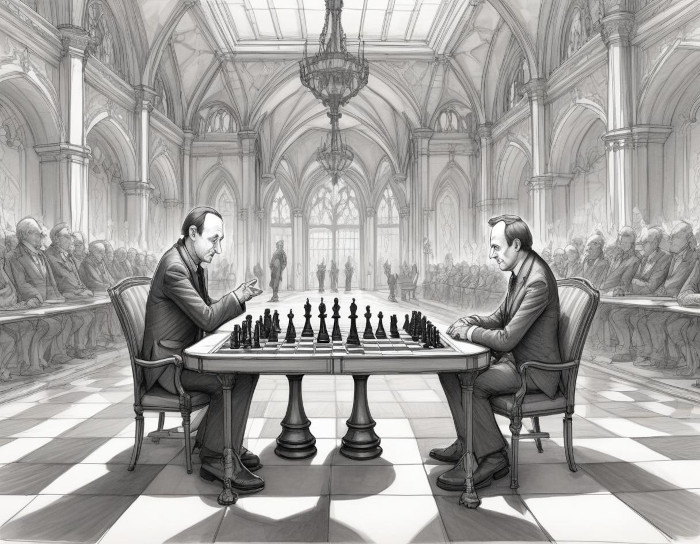
Brzezinski’s vision of the future was not mere speculation or conjecture. He was a member of the ruling class and he spent his life using nations — and their populations — as chess pieces in a game in which most players are dangerously unaware of the reality unfolding around them. In my opinion, Brzezinski’s book describes the unfolding world of the early 2020s.
It is advisable to engage intensively with his work in order to gain fascinating insights into our current situation and the possible direction in which we could be heading.
Now that we know a little about the history of Technocracy and understand its fundamental ideas, it is time to look at the world of today from the perspective of Technocracy.
Let us begin with the wealthiest companies and most influential CEOs. These individuals lead companies that have accumulated immense financial assets and possess unfathomable amounts of digital data about their customers. From Jeff Bezos with Amazon, Bill Gates with Microsoft, Mark Zuckerberg with Facebook, Elon Musk with Tesla to less well-known names at Google, Apple, and others — these are the technocrats of the early 2020s. Interestingly, Musk appears to be following a similar path to his grandfather Joshua Haldeman, who was the research director at “Technocracy Incorporated of Canada” and national chairman of the “Social Credit Party.”
This group of people and their colleagues in other technological industries have immense power through their companies, their wealth, and their cultural influence. They have enough money, resources, and connections to, for example, influence elections, manipulate the climate, and exert influence on the stock market. They are the technocrat class of today.
I want to remind the potential future reader that these names may no longer mean anything in the distant future — they could actually be relics of a long-gone era. Regardless of the names of the companies, CEOs, and governments that fill these roles, the concerns and possible solutions remain the same. If technology continues to advance exponentially, it is likely that the trend toward surveillance will also continue. With the loss of privacy comes a decline in individual freedoms. That is what we want to try to overcome.
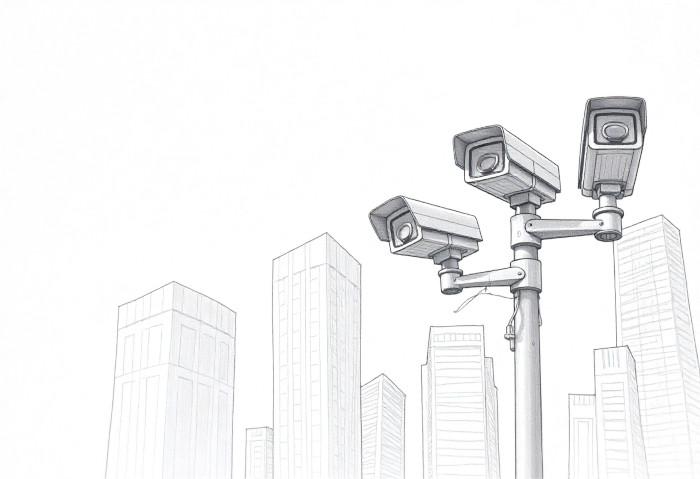
Another aspect of the technocratic world is the increasing use of surveillance tools such as facial recognition, voice recognition, 24/7 video surveillance cameras, artificial intelligence, algorithmic manipulation, phone tracking, social media monitoring, location tracking, digital eavesdropping via smart devices, and the general trend toward a “Smart Grid” controlled by 5G and potentially 6G. Of course, these technologies are not advertised as surveillance instruments, but rather as tools for security, convenience, education, and profit. The result, however, is the same: individuals and companies promote technological solutions for the world’s problems, leading to a loss of individual freedoms and increasing centralized control.
Naturally, the necessity of a fully networked digital world, in which technologists and scientific experts organize our lives, is sold to society, supported by a healthy dose of propaganda from every state’s favorite accomplice, the corporate and state media. Brzezinski’s book “Between Two Ages” offers further insights into the technocratic plan:
“In the technetronic society, the trend seems to be toward aggregating the individual support of millions of unorganized citizens who can be reached by charismatic and attractive personalities, and effectively using the latest communication techniques to manipulate emotions and control reason. [Emphasis by the author]”
Together, the technocrats (also known as Big Tech), their obedient friends in the media, and their partners in governments form the so-called Technocratic State. The rest of this book is dedicated to the task of punching holes in this technocratic state and exploiting its weaknesses. As mentioned in the introduction, if we want to preserve privacy and freedom, we must adapt to constantly evolving technologies that can potentially liberate or imprison our hearts and minds. I believe that the key to resisting technocracy lies in the work of Samuel Konkin III and his theory of counter-economics (Counter-Economics).