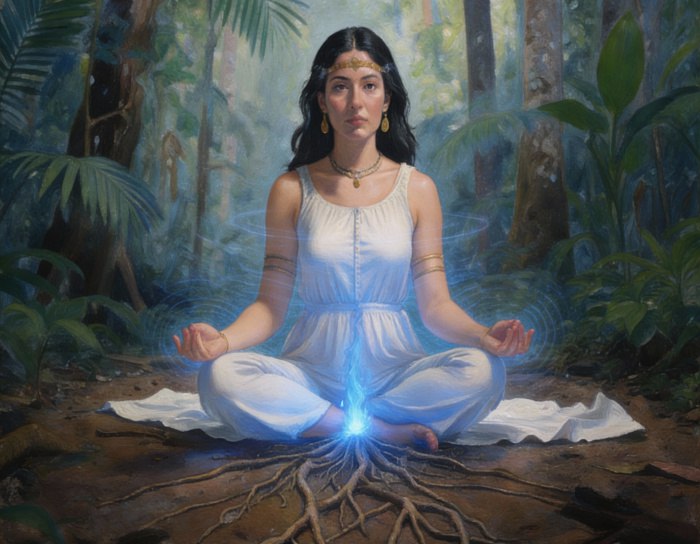
Rediscovering Our Indigenous Essence
Beneath the layers of civilization and conditioning lies an indigenous essence in each of us. This article explores how to rediscover and reactivate our innate connection to nature, community and life itself.
When we have now understood that there is a far more profound and coherent interpretation of the concept of Indigenous than society suggests to us. An explanation that reconnects us more closely with ourselves and provides us with a guide for long-term happiness and meaningfulness. Whose interpretation is by no means new, but rather represents a linguistic reformulation of the ancient wisdom teachings of all indigenous peoples of this world.
When we are equally willing, on the basis of this intuitive and logical interpretation of the concept of Indigenous, to take an honest inventory of our own way of life and of the present society. Then we can seriously work to free ourselves from delusions and realign our lives in the direction of happiness and meaningfulness. For this process, we have contrasted the indigenous and the exogenous way of life and attempted to describe them as far as possible. Thereby we have created a space in which we can classify our own patterns of thought and action. On this basis, we can now think concretely about what we can change in our way of life in order to move again in the direction of an indigenous existence. This article provides some reflections and approaches for this awakening.
Recognize the Shadows on the Wall
In Plato's famous allegory of the cave, people have been sitting chained in a cave since birth. They see only shadows on the wall, caused by things being carried past a fire behind them. They regard the chains as normal, since they know nothing else, and take the shadows for reality. Only when one of the prisoners is freed and moves out of the cave into the light does he recognize that his previous reality was an illusion.
With his allegory, Plato describes the state of exogenous existence in a perfect way. The prisoners are completely oriented outward. Their perceptions, their attribution of meaning, and their self-understanding are generated from outside. The shadows on the wall are presented to them and the prisoners derive meaning, security, and orientation from these projections. In this context, the chains of the prisoners are in truth psychological dependencies, such as the need for recognition, the fear of deviation, and trust in external authorities. This timeless model of social external determination can also be applied to our modern society. The cave of the modern world is omnipresent. It extends from the cradle to the grave, from school through the workplace to digital self-presentation. The chains are not made of iron, but consist of social contracts, curricula, electoral systems, performance metrics, taxes, insurance, credits, and social expectations. The modern person is not chained because they have no choice, but because they were never taught to exist without external orientation.
In such a society, states, corporations, and global institutions function not primarily through coercion, but through the delegation of responsibility. The person hands over their judgment to systems that claim to know better. Happiness is simulated in the form of pleasure. External distractions replace inner peace. The emptier the inner space, the louder the external stimuli must be. Society systematically produces neediness in order to then satisfy it. Thus the exogenous person emerges: someone who thinks, feels, and decides because it is expected of them, not because it arises from within themselves.
The globalized cave pursues the clear goal of control and predictability. People are meant to be calculable, steerable, and optimizable. Exogenous existence is ideal for this. In this mode of existence, people reflect their perception outward.
To dare the exit from the cave, it is therefore crucial to recognize the shadows on the wall for what they are. Media reporting, political stages, social media, Hollywood, mass entertainment, and all these external distractions and stimuli serve to control your perception and keep you in an exogenous mode of existence. When one wants to control and steer the mind, it must be constantly distracted.
Indigenous happiness capacity would be dangerous, for a person who is content from within does not consume compulsively, does not obey out of fear, and is not arbitrarily steerable. An indigenous existence follows no law, no statistic, no market, and no ideology. It is not compatible with total control.
This does not mean, however, that you should abandon all materialistic desires and worldly pleasures from one day to the next and meditate in the forest all day long. It is rather about understanding one's own human mind and one's own patterns of action. Everything else follows by itself. Question all norms, laws, and social traditions. Define your own values and principles and live by them. Free yourself from patterns of thought and action that do not make you happy in the long run — regardless of social expectations and conventions. Recognize the shadows on the wall.
Generate Happiness in Your Life
Try to integrate behaviors and habits into your daily life that bring you happiness. To put it in a natural science context: release serotonin in your body. This neurochemical messenger substance is, as discussed in the previous article, associated with the generation of happiness and contentment.
The strongest natural serotonin boosters are physical movement, sunlight, social connectedness, meaningfulness, and relaxation. When the weather permits and the sun is shining, go outside into the fresh air and move. Go for a bike ride, a run, or a swim. Regular physical movement also keeps you fit. That alone, however, does not yet make for a healthy and happy mind. A healthy mind and character, however, make the best of what one's own physique has to offer. One does not need to do competitive sports. Rather, appropriate daily movement is beneficial.
Further serotonin boosters are sunlight, movement in nature, and meditation. Meditation is a collective term for techniques for self-regulation of attention and consciousness that promote inner calm and clarity. This does not mean that one must necessarily look toward the sky in a cross-legged position; rather, meditation can be lived individually. One can meditate while walking or lying down. Decisive is the conscious cultivation of attention and consciousness. Everyone can meditate; mindfulness and contemplation are also forms of meditation.
What connects daily movement, sunlight, nature, and meditation is a regular walk in the park. Try to use the sunny hours for this. You do best by making it a weekly routine and going alone and without external audio such as music or podcasts. Use this time to reflect on yourself, and give your mind the opportunity to settle for a moment.
Another decisive aspect is a healthy sleep-wake rhythm. Serotonin is a precursor of melatonin, so regular sleep stabilizes the serotonin balance. When you follow the natural daily rhythm of your body, biological processes such as hormone secretion, cardiovascular health, and glucose breakdown adjust correctly. A life in harmony with the solar cycle, in which one goes to bed early and rises early, is the most effective way to live in harmony with nature. A healthy rhythm enables the body to develop its own "alarm clock." Ideally, a person should wake up naturally about six to eight hours after falling asleep. If you wake up at night, this indicates that you may not have expended enough physical or mental energy during the day. A healthy sleep rhythm ultimately sharpens our mind, gives us more life energy, and generally simplifies all subsequent decisions. Therefore, in normal circumstances, forego late-night parties, alcohol, and other behaviors that disturb the sleep rhythm. Instead, suggest a daytime meeting to your "party friends," as this generally creates stronger bonds than celebrating.
Another foundational building block on the path to a happy life is one's own creative productivity and its realization. Creative work is more than just a hobby: it is the transformation of one's own inner life force into new thoughts, inventions, and great concepts. One's own creative work can encompass any form of art, the writing of articles or books, work with music, painting and drawing, working with wood, or exploring new concepts. Creative work should not come from financial or intellectual reasons, but from one's own inner drive and be fed from one's own creative power. Find the creative work that suits you and try things out. Give your inner creative power an opportunity to realize itself.
Work on Yourself
The concept of the indigenous and exogenous mode of existence can also be found in the works of many formative psychoanalysts. For example, the founder of Analytical Psychology, Carl Gustav Jung, speaks of a fundamental drive toward healing anchored in the human psyche, which he calls the individuation process. This innate healing intelligence corresponds to our indigenous essence. Since the indigenous mode of existence is the most natural form of human being, we can dissolve personal traumas and delusions by directing our attention to our inherent healing intelligence. On this fundamental idea are based the trauma therapy of Gabor Maté, the bioenergetics of Alexander Lowen, and the transpersonal psychology of Stanislav Grof. If one engages more closely with these ideas and concepts, one can deal with one's own traumas and delusions and embark on one's own path of healing.
If one considers the ancient perspectives and practices of all indigenous peoples of this world, one finds that our ancestors invested much time and energy in spiritual healing. In doing so, they combined in various ways the ingestion of entheogens, drumming and other forms of percussion, music, chanting, rhythmic dance, changes in breathing patterns, and the cultivation of special forms of attention. If we want to live in harmony with ourselves, it is time to no longer regard these practices as ignorance, magical thinking, and primitive superstition, but to overcome the dogmatic materialistic worldview of modern societies.
Universal Connectedness
As already discussed in our article series on natural law, we as the entire human race are connected to one another. The division and fragmentation of humanity is thereby the greatest exogenous force that directs our perception outward and focuses us on apparent differences. The more people strive for an indigenous mode of existence, the better the conditions become for others to do likewise. In all ancient wisdom teachings, one therefore finds the meaningful spiritual guiding principle:
"I can do nothing for you, except work on myself.
You can do nothing for me, except work on yourself."
This wisdom is very powerful and valuable, for it states that true help is achieved through personal responsibility and example. People who focus on their own inner well-being are often called selfish in our society. But this belief is false. Our true reason to achieve the highest, lasting inner peace is to help others do the same. This does not mean, however, that we should no longer help others. Sometimes we can help others by providing them with money or better material circumstances. On the path to inner peace, every person needs good physical health as well as certain external circumstances such as food and a pleasant environment.
We should keep in mind, however, that the greatest help we can offer is to assist others in overcoming their delusions and discovering true, lasting happiness within themselves. The best we can achieve is to bring people into a situation that allows them a temporary respite from their problems and difficulties. True, lasting happiness we cannot give them. For the true cause of happiness is inner peace, and that is to be found only in one's own mind, not in external circumstances.
Living with compassionate connectedness in a society based on division and delusion is very challenging. In fact, it is very painful and requires courage and perseverance to face all these truths described here. The path out of the cave is extremely challenging. The light is blinding, and the old order crumbles. But the path is worth it. One begins to construct reality no longer from desires, social expectations, and material possessions, but from direct experience. The light stands for a new mode of being. But this mode of existence can only emerge from within oneself. That is why it is so difficult to convince others of these truths. Plato already teaches us this. When the freed one returns to the cave to free the others, he is laughed at and threatened. From an exogenous perspective, the indigenous person appears dangerous and crazy. They can no longer take the shadows seriously and refuse the rules of the game. Thereby they attack the worldview of every exogenous person. The cave-dwellers defend their dependency. They fear the loss of external standards, because they do not know how to deal with the inner source. This is deeply understandable and should be met with understanding.
Series: Indigenous
- 1What Does "Indigenous" Mean?
- 2Indigenous & Exogenous as Pillars of Human Existence
- 3Rediscovering Our Indigenous Essence
You might also like
New articles directly on Telegram
Follow @agorahoch3 and never miss a new post.