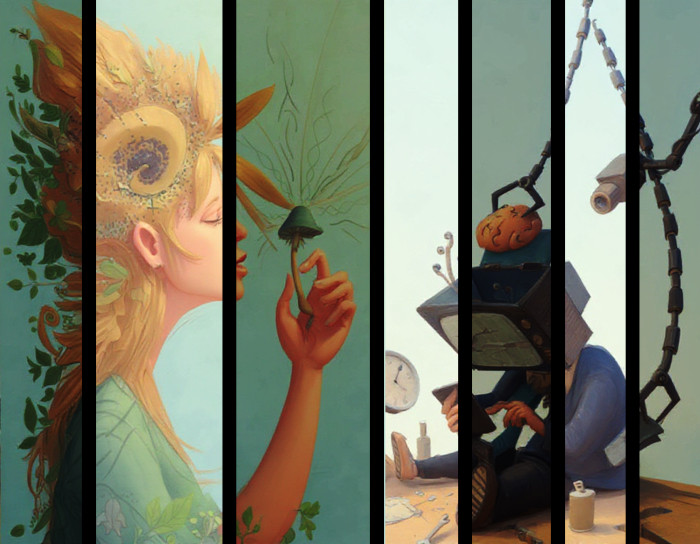
Indigenous & Exogenous as Pillars of Human Existence
Indigenous and exogenous — the internal and the external — are two fundamental dimensions of human existence. Understanding their relationship offers a framework for navigating modern life with greater clarity and freedom.
If one understands the term indigenous in its original, ancient form as the description of a human mode of existence, then an indigenous person creates happiness and meaningfulness from within themselves and generates meaning and knowledge from a state of being. Following this logic, every person therefore carries the indigenous essence within themselves. It is not limited to a particular nationality, ethnicity, or culture and describes the most natural state of mind of human being.
Many of the still-existing so-called indigenous peoples of this world live in deep connectedness with nature. From the perspective of the Western world, they are known for their simple and surprisingly happy lives. They are therefore rightly associated with the term indigenous. Even though this term in prevailing usage functions more as a geographic-ethnic label. This label is assigned by the socially leading institutions and governments and allows the identity of such ethnic groups to be shifted into the external, manageable, and controllable sphere. A term that describes creation "from within" thus becomes an instrument of administration and control "from without."
The Canadian anthropologist Jeremy Narby, who lived for two years with the Asháninka Indians in the Peruvian Amazon, summarizes the dilemma of indigenous peoples in his bestseller "The Cosmic Serpent" as follows (pp. 152 ff.):
"First, they must come to terms with the loss that history has inflicted on them in order to acknowledge the true value of their knowledge. In the last 500 years, Western civilization has drilled into indigenous peoples that they know nothing, so that some of them have come to believe this. For them to appreciate the value of their own knowledge, they must come to terms with having been misled. Second, there is the question of money. An indigenous culture with sufficient territory and bilingual and intercultural education is better able to preserve and maintain its mythology and shamanism. Conversely, the confiscation of their land and the imposition of a foreign education, through which their young people become amnesiac, threatens not only the survival of these people but also that of an entire way of knowing. It is as if one were burning down the oldest universities in the world and their libraries one by one, thereby sacrificing the knowledge of future generations."
Happiness vs. Pleasure
In fact, the indigenous mode of existence can be described as an expression of the human striving for happiness. It is a way of life that must be lived every moment and that no one can possess or bestow. Although all living beings have the same basic desire to be happy all the time, very few people understand the true causes of happiness. Normally, we believe that external circumstances such as food, friends, cars, travel, houses, or money are the cause of happiness. Therefore, we use almost all of our lifetime and energy in the striving for these things. On the surface, it seems as though these things can make us happy. According to the values of our modern, materialistic society, these things are worth striving for and make one happy.
Following this logic, with technological progress that makes our lives ever more comfortable and showers us with technologies, the mental health of humanity should also flourish. But it is precisely here that the entire logic of modern society falls apart. For in fact, the psychological problems of a society increase with technological progress and materialistic prosperity. The causes of this are very complex and are still intensively discussed today.
For the purpose of this investigation, we want to focus on the difference between happiness and pleasure. Although both emotional states resemble each other in some respects, they are the product of two different ways of life. These ways of life can, as we will see later, be described as indigenous and exogenous.
Whoever seeks their happiness in creating a life that includes pleasure in any form as often as possible will only be satisfied when they are experiencing pleasure. Pleasure can be produced by external stimuli of any kind and is characterized by the short-term release of dopamine and opiates in the body. All forms of human addiction are based on the release of these neurochemical substances. This includes all external stimuli that we can consume in any form and that are thus of a materialistic nature. These include sex, gambling, the internet, relationships, shopping, food, work, extreme sports, fitness, pornography, and any other human activity.
Happiness or contentment, on the other hand, are based on the neurochemical fuel serotonin, which is released more evenly and slowly. The strongest natural serotonin boosters are physical movement, sunlight, social connectedness, meaningfulness, and relaxation. These are all things for which one need not possess anything in the materialistic sense, but which are accessible through the mere human being in this world.
Thus all human pleasures are of an exogenous nature, since they are supplied from outside through a specific desire. Happiness or contentment, on the other hand, are of an indigenous nature, since they can be generated from within independently of external circumstances.
The feeling one experiences when the world stands still for a moment and one is free from external stimuli and desires gives insight into one's own happiness. This wisdom is found in virtually all religious and mystical teachings of humanity and is by no means new. Thus, for example, Buddhist wisdom states: "Happiness arises when desire ends."
Self-Determination vs. External Determination
Since every person naturally carries the indigenous essence and thus the source of peace and happiness within themselves, one wonders why it is so difficult for most people to maintain a persistently peaceful and joyful mind. It is as though our minds are always under the control of at least subtle forms of delusion, which results in daily frustration. It is as though we are constantly chasing mirages, only to be disappointed that they do not give us the hoped-for satisfaction. These delusions have their origin in virtually all areas of modern society.
We live in a world that sells us pleasure as happiness. Wealth and success are defined in terms of money, social distinctions, and possessions. Knowledge is imparted from the outside inward from childhood. In the process, one goes through a socially prescribed checklist in the hope of leading a happy and fulfilling life. Always with the premise that the better one follows the prevailing social narrative, the more successful one is. Of course, as human beings we are always dependent on our immediate environment and must integrate into the society in which we want to live. The decisive factor, however, is the moral foundations on which the society is built and the extent to which a self-determined life is promoted and social norms liberate us.
Whoever grows up in our society today is born into external determination. From childhood one learns a limiting self-perception. Already with entry into the state school system, one is only successful and can set the course for a socially successful future if one bows to the prescribed social values. In school, a child learns that obedience is important and that mistakes are forbidden. Mistakes are associated with bad grades, reprimands, trouble, and ultimately failure. A child is no longer allowed to experiment and find out for themselves how something works. Every mistake conveys to the young mind that they are doing something wrong. Thus one learns from an early age that only the socially prescribed values are important and that all personal feelings that might contradict these values are to be suppressed. They learn to feel unimportant. The child learns that they have almost no influence and must function primarily as a receiver of orders.
Modern people are educated to seek support and guidance in the value framework prescribed by society. Moreover, it is about the permanent spread of fear, chaos, and uncertainty toward the unknown. Modern people are meant to fear the exit from the established social framework. All manner of apparent comforts and securities are brought into play. Through this combination, modern people are too insecure to generate happiness and meaningfulness from within themselves. Therefore they seek the apparent security of social standards for happiness and success. It is about having, because being is never secure. One's own actions and life decisions are unconsciously based on the idea of maximizing control through security. Security through the prescribed social values and control for suppressing one's own inner insecurity. When society prescribes how one should dress, pay taxes, or work until retirement, then an insecure mind can only gain the recognition of society by fulfilling these requirements. Such a mode of existence is externally determined by society and creates a lifelong dependency. The person is then no longer "born from within" but constructed from outside by systems and narratives.
Our perfection depends on the opinion and approval of other people. We exist in the imagination of others and thus live an exogenous life. This external determination from preschool to retirement age suppresses one's own inner voice. For those who are always told what to do and what not to do in order to "function" in this society have never had time to listen to themselves. From this insecurity of not being able to listen to oneself, one seeks all the more strongly the confirmation from outside in the socially prescribed values.
Summary
The terms indigenous and exogenous describe two fundamental modes of existence, two different ways of orienting oneself toward oneself and the world, two character structures whose respective dominance determines how a person thinks, feels, and acts. The indigenous mode of existence is about vitality and authentic relatedness to the world. It describes the true nature and reality of a person. Personal responsibility, authenticity, and self-determination are defining features of this way of life.
The exogenous mode of existence is based on the idea that happiness and meaningfulness can be generated from outside. It manifests through a lack of self-worth and a false self-perception. Due to this inner insecurity, one automatically seeks appreciation and stability from outside. The lack of self-confidence in following one's own inner voice and doing what one is passionate about is a product of modern society. The exogenous way of life is based on the constant search for pleasure and social recognition. It stands in contrast to the indigenous way of life.
Like minus and plus poles, these two perspectives define the foundational pillars of human being. In fact, this analogy is very apt, since through our thoughts and actions we can repolarize ourselves and thus move in one direction or the other.
The distinction of human modes of existence into indigenous vs. exogenous is not a new perspective, but is found in modified form and with different symbolism in virtually all religions and philosophies. Aristotle already knew that happiness (Eudaimonia) arises through the realization of one's own nature and not through possessions, status, or external goods. Erich Fromm also describes exactly this topic in his work "To Have or to Be." All shamanic myths of this world teach independently of one another that knowledge dwells within us and cannot be taught by external institutions. The Vedic and Buddhist traditions also teach us the same apparently universal and timeless truths with the comparison between "Atman vs. Maya." It is Gnosis vs. Law.
The distinction into indigenous and exogenous is thus nothing more than a linguistic reformulation of thousands-of-years-old wisdom teachings. For this reason, this comparison intuitively makes sense and represents, then as now, a danger for immoral power structures. For wherever people learn that they themselves are the source of knowledge, happiness, and understanding, external control collapses.
Series: Indigenous
- 1What Does "Indigenous" Mean?
- 2Indigenous & Exogenous as Pillars of Human Existence
- 3Rediscovering Our Indigenous Essence
You might also like

New articles directly on Telegram
Follow @agorahoch3 and never miss a new post.