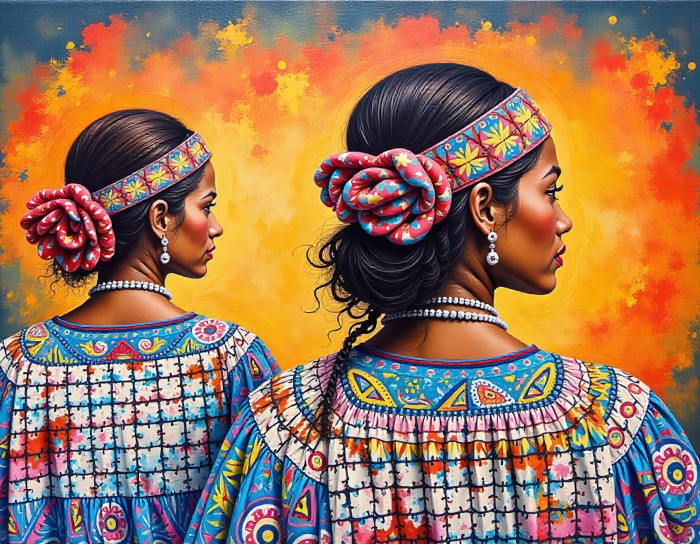
What Does "Indigenous" Mean?
The concept of "indigenous" goes deeper than its official definition. This article explores what it truly means to be indigenous — and what this understanding means for all of us.
According to the Convention of the International Labour Organization (ILO 169), which entered into force in 1991 and has since been ratified by countries such as Bolivia, Mexico, Norway, and Spain, a community is considered indigenous if it lived at its place of settlement before the arrival of other population groups and has partially or fully preserved its own social, economic, cultural, and political institutions. Additionally, the community must identify itself as indigenous. Accordingly, the Quechua in Bolivia, the Maya in Mexico, or the Sami in Norway formally belong to the indigenous peoples. The term indigenous is derived from the Latin word for "native" — indigena. In this context, the term is a location-dependent characteristic for "born on the spot." This interpretation of the term goes back to the Roman Empire. Thus, around 19 BC, Virgil designated with "indigenae Italici" the natives of Italy who had already settled the land before the arriving Trojans.
Modern Usage
Today, the term indigenous is used officially to separate certain population groups from one another. This refers to various ethnic groups that distinguish themselves from the majority society through their cultural characteristics such as traditions, languages, and worldviews, and that were or are still being displaced through colonization, migration, and state formation. Governments and other centralized organizations can grant or deny the status of indigenous to various groups of people. Thus, political agreements such as the aforementioned ILO 169 serve as the basis for protection programs, land rights, and special cultural rights. According to socially leading institutions such as the United Nations (UN), approximately 476 million people today officially qualify as indigenous.
By this, indigenous peoples are to be officially protected from land grabbing and their language, rituals, and knowledge are to be preserved. There is no officially recognized objective time limit for how long a group of people must have lived in a place to count as indigenous. Equally, there is no universal recognition of these indigenous peoples by all governments of the world. For example, the German government does not recognize any indigenous peoples within the meaning of the ILO Convention on its own territory. The category indigenous would give rise to demands for land rights, cultural self-governance, and political autonomy, which is why Sorbs, Frisians, or Sinti and Roma are considered merely as minorities. Ethnic Germans are also not regarded as indigenous, as they are classified by the state as the "majority society" and the term indigenous is not officially used as a universal anthropological category.
A glance across the Atlantic reveals a similar picture. In Canada, the government has been determining indigenous affiliations since 1876 through the Indian Act. Accordingly, only those who are registered in a state register count as indigenous. Through this administrative definition, the state can determine who is entitled to land and compensation and who is considered to have "merged into civilization" and is therefore no longer recognized as indigenous.
During the era of colonization, the indigenous term also played a significant role. Thus, in the French colonies such as Algeria, West Africa, or Indochina, the colonized populations were officially referred to as indigènes. The term served to separate rights and duties. The indigènes stood outside French civil law. They were subject to a special penal code, the so-called Code de l'indigénat, which permitted arbitrary punishments, forced labor, and disenfranchisement.
Spain also referred to the population of its colonies in America, Africa, and Asia as indígena during the colonial era. However, the term was never applied to the Iberian minorities living in Spain, such as the Basques or Catalans, since such a universal application of the term — similar to the German example — would mean a structural loss of power on one's own territory.
An apparently positive-looking example was Bolivia under Evo Morales. In 2006, indigenous identity became the central identity axis of the state under the new president. Land rights and cultural autonomy were expanded. Thereby, however, the term was also strongly instrumentalized. Those who positioned themselves politically against the government risked being called "not truly indigenous." While the term indigenous was not used here as a stigma as in the French or Spanish colonies, but rather as a distinction, the mechanism of power remained the same.
In summary, the term indigenous is used in today's parlance for political purposes to legitimize claims to land, rights, or autonomy. The identity of an ethnic group is thereby shifted into the external, manageable, juridical sphere in order to control conflicts, define minorities, create protection programs, and politicize identities. With the term indigenous, societal groups are separated that have hitherto existed outside of state laws and sociopolitical power structures, in order to better integrate them into these structures. These peoples receive legal recognition, political participation, and additional financial resources, which are, however, frequently unequally distributed and incomplete. The actual result of these measures is in many cases the bureaucratization of indigenous identities through state programs and the embedding of indigenous organizations in state control mechanisms. Moreover, every government and every institution can itself determine which population groups it recognizes as indigenous. This makes the term a label of political categorization and power management.
The term indigenous has been corrupted by the prevailing global power relations and on this basis continues to be politically misused and misinterpreted to this day.
Let us now free ourselves from this socially prescribed interpretation of the term and interpret the concept of indigenous from a new perspective. In fact, the indigenous essence is present in every human being and is neither dependent on the judgment of other people nor bound to time, place, or culture.
Ancient Interpretation
If we want to properly understand the term indigenous, we must look back to antiquity. The term indigena originates from classical antiquity and is closely associated with the Greek idea of the autochthonous human being. Autochthon means something like "sprung from the earth itself." Roman literature transmitted this Greek concept with the word indigena.
The Latin term is a combination of the words indu: from within and gignere: to generate. That is, the term indigenous literally stands for "generating from within" and can be translated in meaning as "born from within." This meaning of the word corresponds to the original translation of the Greek word autochthonos. Thus, in its origin the term has no relation to ethnicity, property, or borders. Indigenous does not describe a belonging to a land, but a belonging to oneself — essentially a connection to one's own being. Whether a person lives indigenously or not is bound neither to a place nor to a time. Equally, self-proclaimed authorities cannot grant or withdraw this status from other people or a community, since it is a state of being and not of having.
The term indigenous describes an inner state of mind and the embodiment of a personal way of life. Indigenous people generate meaning and knowledge literally from within themselves. Such a person lives from their own nature and reason. The indigenous essence is thus present in every human being and describes the most natural form of mental autonomy. In contrast to the geographically-historical interpretation transmitted today, this interpretation applies to all people in every historical moment and regardless of ethnicity, origin, or culture.
A so-called Indigena in their original meaning carries the essence of freedom within themselves. They generate meaning, knowledge, and happiness from within themselves. They live in harmony with the laws of nature, are self-sufficient and sovereign, and can therefore not be controlled or manipulated through fear. They are not a product of external systems, but an expression of an inner truth. Knowledge is therefore not a product of external sources and authorities, but a lifelong process of inner insight.
The Social Dynamic of Both Interpretations
In modern usage, the original meaning of the term indigenous has been nearly turned on its head. During colonization, for example, indigenous did not represent "born from within," but instead became a geopolitical label for "ruled from without." The universal concept of consciousness indigenous was reformulated into a sociopolitical category.
The leading institutions of this world promote and stabilize, within the framework of state power logic, an interpretation of indigenous as a historical group identity, in order to neutralize the potentially system-threatening principle of freedom. The focus on ethnicity, history, and geography divides humanity, is politically workable and controllable. The concept of inner autonomy and a free, sovereign spirit is suppressed, since people in this mode of existence cannot be manipulated or governed.
The modern, external meaning of the term indigenous keeps humanity captive in a power-political control scheme and shifts the social discourse to questions of guilt, ownership claims, and minority discourses. The reinterpretation into a geographically-ethnic label is a subtle form of disempowerment. It separates people from the universal indigenous source within themselves and replaces it with an administrable identity in the external world.
Indigenous is and remains, however, in truth a state of being that every culture and every person can embody at any time.
Series: Indigenous
- 1What Does "Indigenous" Mean?
- 2Indigenous & Exogenous as Pillars of Human Existence
- 3Rediscovering Our Indigenous Essence
You might also like

New articles directly on Telegram
Follow @agorahoch3 and never miss a new post.