Never Again Has Been a Long Time
On the anniversary of the Peaceful Revolution of 1989: how Leipzig manages the legacy of '89 between a Festival of Lights and an arms factory, war rhetoric and democracy speeches.
The Peaceful Revolution is an integral part of German history and undoubtedly a bright spot in many respects. On October 9, 1989, over 70,000 peaceful demonstrators marched through Leipzig and overcame — according to the Federal Agency for Civic Education — their fear of reprisals and secret police. On that autumn evening, the people stood together in strict non-violence. They belonged to no particular party and represented no specific social class. They also denied the state any pretext for violence by remaining peaceful themselves. On that autumn day, the people marked the final turning point in GDR history. And all of this without ballot boxes or petitions. They showed that they were the majority against the repressive socialist apparatus of power. That they were the people. One month later, the Berlin Wall would fall.
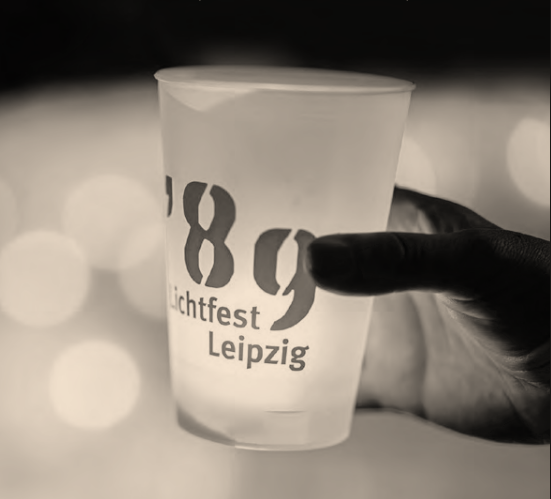
Leipzig commemorates this bright spot every year with its specially organized Festival of Lights. Around 37 years after the historic events, however, the question arises of how far the values of that evening still occupy the center of public life. That October day was a wake-up call for all citizens to finally stand together against the repressive state apparatus. It was the people’s will for peace, freedom, and solidarity. With that in mind, let us take a shared look at the celebrations — and at Germany in the year 2026.
Welcome Message
Burkhard Jung, the city’s mayor, traditionally uses the occasion to present himself in a favorable light. In his official welcome message for 2026, he emphasizes that the radical transformation of the until-then dictatorially controlled social, political, and economic order in socialist Germany was achieved peacefully, and that on October 9 people wish to celebrate freedom and democracy together. This 37th anniversary, however, has a bitter aftertaste. Just a few kilometers from the Festival of Lights, a US-Israeli defense start-up is set to manufacture its “Anthem” cruise missiles in northern Leipzig next year. The medium-range rockets produced there are said to have a range of over 1,500 kilometers, reaching deep into the East. Initial annual production is planned at just under 1,000 units — built to be used, actively, for military purposes. In an interview with Radio Leipzig, Jung recently endorsed the company’s construction plans, even speaking of a current “pre-war situation.” Meanwhile, the German federal government also wants a broad arsenal of medium-range missiles in order to be “war-ready” in the near future. That Leipzig and the missile production site would thereby become a strategic target for the opposing side seems to Jung a distant problem for “his region.” The controversial alleged drone attack on Leipzig Airport in early August now conveniently plays into the hands of political decision-makers promoting a new local war industry.
It is also worth saying a few words about the new US-Israeli start-up that will soon — if the mayor has his way — bring new jobs and tax revenue to Saxony. The company Covenant was founded in 2024 with millions in funding from Peter Thiel’s venture capital firm Founders Fund. Its CEO and co-founder Michael Kaufman is also a former employee of Thiel Capital. There is much to say about Frankfurt-born Peter Thiel, and not a few people count him among the most influential figures in the world today. Most intriguing in this context is his privately founded, high-profile conference series “Dialog.” Thanks to the support of a Swiss activist and hacker, the “Dialog Leak” gave us a glimpse into the participant lists of recent years and the agenda of the conference held last August in Dublin. The results of confidential discussions on topics such as “Mastering World War Three,” “Create a Cult,” “Battlefield Technology,” or “It’s Fun to Be in Charge” remain unknown. Jens Spahn cannot help us here either — after the “Dialog Leak” became public, he, having participated successfully many times in previous years, regretfully cancelled his attendance this time.
So Mayor Jung speaks in this year’s Festival of Lights welcome message of a “peaceful atmosphere” while simultaneously, in a situation he himself calls pre-war, promoting a new war industry in Leipzig. The European Parliament’s Readiness 2030 rearmament program fits the same narrative, aiming to make EU member states war-ready by 2030 with up to 800 billion euros. It seems as though World War Three is already a foregone conclusion — yet once again, not a single citizen of those potential warring nations was consulted.
Speech on Democracy
This year’s Democracy Speech at the Festival of Lights will be delivered by German-American political scientist Cathryn Clüver Ashbrook — described in the program as “one of the most prominent transatlantic voices of our time.” Admittedly a very deliberate choice. With various Young Leader programs and degrees from the London School of Economics and Harvard, she fits the classic profile of transatlantic elite formation. Since 2022 she has been Senior Advisor at the Bertelsmann empire and holds several other noteworthy positions. She is currently Vice President of the lobbying association United Europe, which regularly organizes exclusive and confidential “CEO Roundtable” formats. These bring together, according to the organization, “select groups of business leaders with senior European politicians and experts to discuss topics relevant to their companies’ futures.” From 2021 to 2025 she also served on the Advisory Board of Monarch, a private military intelligence service that cooperates with the Atlantik-Brücke and was founded in 2021 by former BND president Gerhard Schindler. Schindler himself had to step down from the state intelligence service ten years ago after the BND’s illegal mass surveillance was revealed through the Snowden disclosures.
In addition to this already remarkable résumé, Ms. Ashbrook holds one more decisive trump card: she is regarded in Germany as the foremost Trump expert and one of the most sought-after commentators on current foreign and security policy developments. It is easy, of course, to point out the obvious totalitarian and dictatorial excesses of the Mango Mussolini overseas. But ultimately, Big Donald’s star on the Hollywood Walk of Fame exists for a reason. Enough has already been said about the showman. It would be equally easy to pass judgment on the despot and autocrat Vladimir Putin, who tramples on human rights and freedom of expression as any successful ruler does.
But since one should be most critical of oneself — and we are Europeans — let us sweep most thoroughly before our own door.
Ms. Ashbrook is emblematic of a new and increasingly vocal supranational movement in Europe toward a centralized, institutionalized, and increasingly repressive apparatus of power in Brussels. And for that purpose she can play her trump card perfectly. For if Ashbrook has her way, it is time for Europe to shift to its own version of a war economy — everything must be on the table, from common debt and tax increases to spending caps and increased innovation expenditure. At the 9th Global Female Leaders Summit she advocated mobilizing private capital for European war-technology start-ups. This does not mean we need to fear a wall being rebuilt in Germany or Europe — though that is less because such a system would not arise, and more because in the 21st century its most efficient form operates in the digital realm for surveillance and control. The EU Parliament is working on chat control. The federal government on a citizen account and digital identity. The ECB on a digital euro. State surveillance technology is advancing. Freedom of expression is under pressure. The suppression of dissidents, government critics, and civil rights activists has become systematic again.
Not least, the National Socialists themselves, in 1944, on the verge of military defeat, dreamed of a new supranational Fourth Reich in Europe. And as US intelligence documents reveal, the Nazis already knew then that this dream could not be achieved militarily, but economically — through European unity and the voluntary surrender of national sovereignty to an international institution. And indeed, the European Union did not emerge through an organic grassroots movement arising from the European peoples. Examples of how former Nazis from industry, media, and banking shaped the post-war era and ultimately the path toward a European Union are plentiful:
Hermann Josef Abs, who from 1940 was a supervisory board member of the notorious I.G. Farben, later served Chancellor Konrad Adenauer as an advisor and remained Honorary Chairman of Deutsche Bank until his death in February 1994. He was also a member of the European League for Economic Co-operation (ELEC), an elite intellectual interest group founded in 1946 dedicated to the creation of a common market — the precursor to the European Union. The first chairman and symbolic figure of the Bilderberg Conferences, held annually since 1954, was former Nazi Prince Bernhard of the Netherlands. The Bilderberg group is another influential elite Round Table organization that worked decisively toward the formal founding of the EU. The Treaties of Rome of 1957, generally considered the cornerstone of today’s European Union, were signed by former Nazi Walter Hallstein. Hallstein was a member of numerous National Socialist organizations and represented the Third Reich as a lawyer in various proceedings. Nonetheless, the EU still describes him today as a “diplomat heart and soul and driving force behind European integration” — for Hallstein served as the first President of the Commission of the European Economic Community (EEC) from 1958 to 1967. The Bertelsmann publishing house under the Mohn family entered into a symbiotic relationship with the Nazi regime and was considered the largest producer of propaganda material in the Third Reich. And although the self-crafted legend of the alleged resistance publisher is now well known, the Bertelsmann empire is still led by the Mohn family today and is more influential than ever in Germany and Europe. The Bertelsmann Foundation, founded in 1977 by Reinhard Mohn, is also one of the most vehement propagandists for a supranational European bloc state — which brings us back to Ms. Ashbrook, the Super Advisor of the Bertelsmann Foundation.
In the end, it does not matter whether the year is 1939, 1989, or 2029. As an informed and free citizen, one should pay attention when it comes to the centralization of power, the restriction of personal freedoms, and obvious war propaganda. The flowery language in which these topics are presented makes no difference. “Never again” is not now — it has been a long time.
Path of Light
One might think it possible to “vote your way out” of this predicament. Unfortunately, history shows that this has never actually worked. The existing “democratic power structures” are designed to give the people the comfortable feeling of having a say. In reality, however, no one in the agenda-setting Round Table groups and supranational institutions is elected by the people any longer.
The opposition parties of left and right are, within this limiting, statist worldview, merely boundary posts. They too want power; they too must work for lobbyists; they too must attend Round Table sessions if they want professional success. The AfD and the Left Party, as fringe parties, voice the obvious criticisms of the existing repressive power structures in order to convince doubters and critics that their perspective is represented within the party spectrum. The saviors are just a vote away. The choice is whether that vote, in its ultimate consequence, comes with a hooked cross or a hammer and sickle. Both are, historically speaking, extremely deadly and misanthropic ideologies — and beyond that, extremist, intolerant, and prone to violence.
The political stage exists to divide, distract, and pacify the people. Through the recurring transfer of power, left and right parties can publicly shift the blame onto each other when it comes to tax increases, restrictions on individual freedoms, or other negative political consequences. Beyond all this, it is questionable to vote for a system that imposes one’s own worldview on one’s neighbor through force and coercion. That is the opposite of diversity and tolerance, and it will never lead to a better world.
What other options are available to us? What would a genuine Peaceful Revolution look like? A Peaceful Revolution against these repressive power structures, this swamp of corporatism, lobbyism, and Round Table groups, this guardian of pseudo-democracy? The answers are surprisingly obvious — and can be found, among other places, by looking back at that autumn of ’89.
The people acted according to their own personal values and principles, defying the restrictive state apparatus. They did so through open disobedience, a deliberate withdrawal from the state economy into a shadow economy, and the courage to stand up for their own freedom. Counter-economics and agorism describe the thousandfold, unspectacular decisions of those citizens to stop playing along — at the ballot box, in commerce, in silence. Those who took to the streets in 1989 had usually learned years earlier that one must do what is forbidden and break immoral laws in order to bring down totalitarian regimes.
That is the experience that should be celebrated in Leipzig on October 9 — and in every present moment.
You might also like

New articles directly on Telegram
Follow @agorahoch3 and never miss a new post.